(g = 9.81 m/s$^2$ = 32.17 ft/s$^2$; $\rho_{water}$ = 1000 kg/m$^3$ = 1.94 slug/ft$^3$, $\rho_{mercury}$ = 13,560 kg/m$^3$ = 26.3 slug/ft$^3$)
Question 1: (30 points)
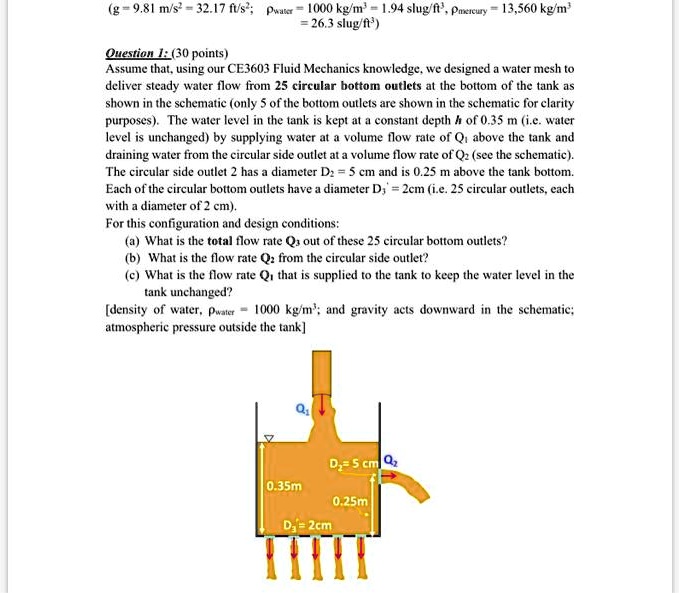
Assume that, using our CE3603 Fluid Mechanics knowledge, we designed a water mesh to deliver steady water flow from 25 circular bottom outlets at the bottom of the tank as shown in the schematic (only 5 of the bottom outlets are shown in the schematic for clarity purposes). The water level in the tank is kept at a constant depth of 0.35 m (i.e. water level is unchanged) by supplying water at a volume flow rate of $Q_1$ above the tank and draining water from the circular side outlet at a volume flow rate of $Q_2$ (see the schematic). The circular side outlet 2 has a diameter $D_2$ = 5 cm and is 0.25 m above the tank bottom. Each of the circular bottom outlets have a diameter $D_3$ = 2cm (i.e. 25 circular outlets, each with a diameter of 2 cm).
For this configuration and design conditions:
(a) What is the total flow rate $Q_3$ out of these 25 circular bottom outlets?
(b) What is the flow rate $Q_2$ from the circular side outlet?
(c) What is the flow rate $Q_1$ that is supplied to the tank to keep the water level in the tank unchanged?
[density of water, $\rho_{water}$ = 1000 kg/m$^3$; and gravity acts downward in the schematic; atmospheric pressure outside the tank]