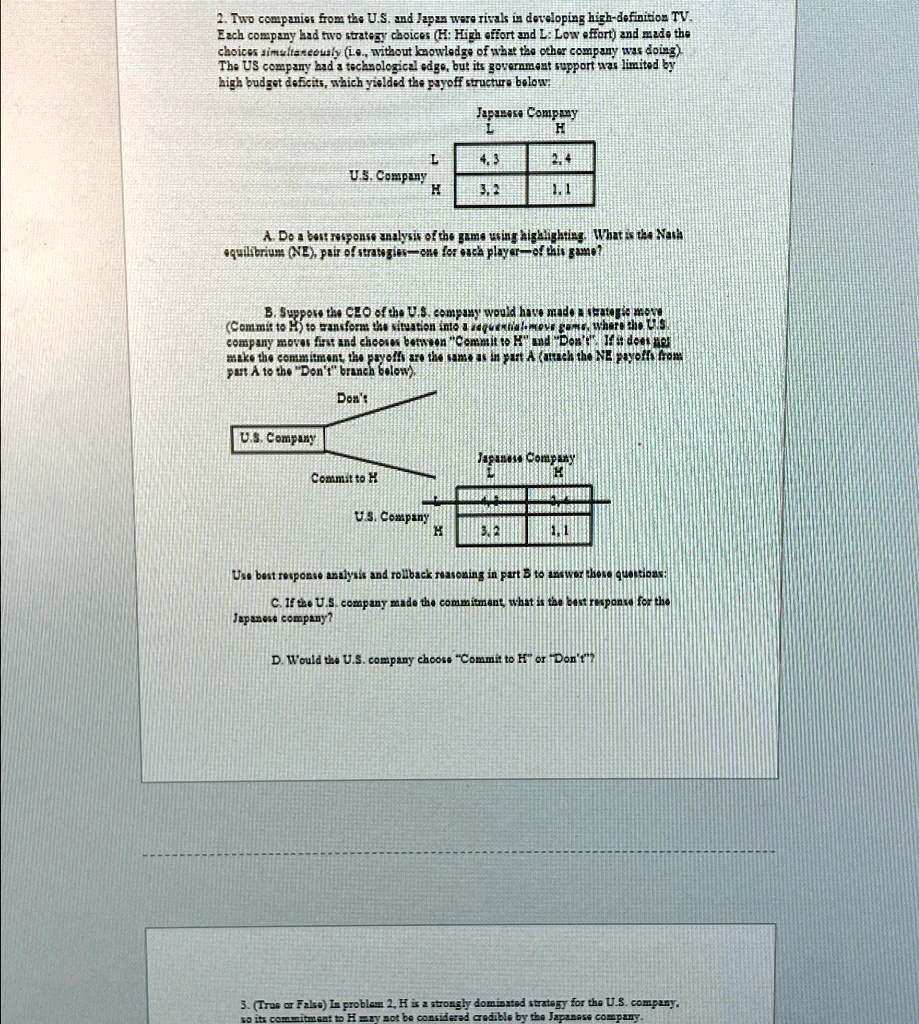
Two companies from the U.S. and Japan were rivals in developing high-definition TV. Each company had two strategy choices (H: High effort and L: Low effort) and made the choices simultaneously, without knowledge of what the other company was doing. The U.S. company had a technological edge, but its government support was limited by high budget deficits, which yielded the payoff structure below:
Japanese Company L H
U.S. Company L 4, 3
H 2, 4
Equilibrium NE pair of strategies - one for each player of this game.
Suppose the CEO of the U.S. company would have made a strategic move. If the U.S. company moves first and chooses between Commit to H and Don't make the commitment, the payoffs are as follows:
Don't:
U.S. Company Japanese Company
Commit to H 3, 12
If the U.S. company made the commitment, what is the best response for the Japanese company? Would the U.S. company choose Commit to H or Don't?
(True or False) In problem 2, H is a strongly dominated strategy for the U.S. company, so its commitment to H may not be considered credible by the Japanese company.