Problem 1: Determine the specific volume of the following states using three different methods:
Method 1: Thermodynamic tables, Method 2: Ideal gas law, Method 3: Generalized compressibility chart.
(a) water vapor at 14 MPa, 370°C.
(b) ammonia at 400 kPa, 70°C.
(c) Refrigerant 22 at 2 MPa, 90°C.
Which of the previous cases can be modeled as an ideal gas with acceptable accuracy?
e
N2
m = 1 kg
V₁ = 1 m³
P₁ = 1 atm
V2=2V1
Patm = 1 atm
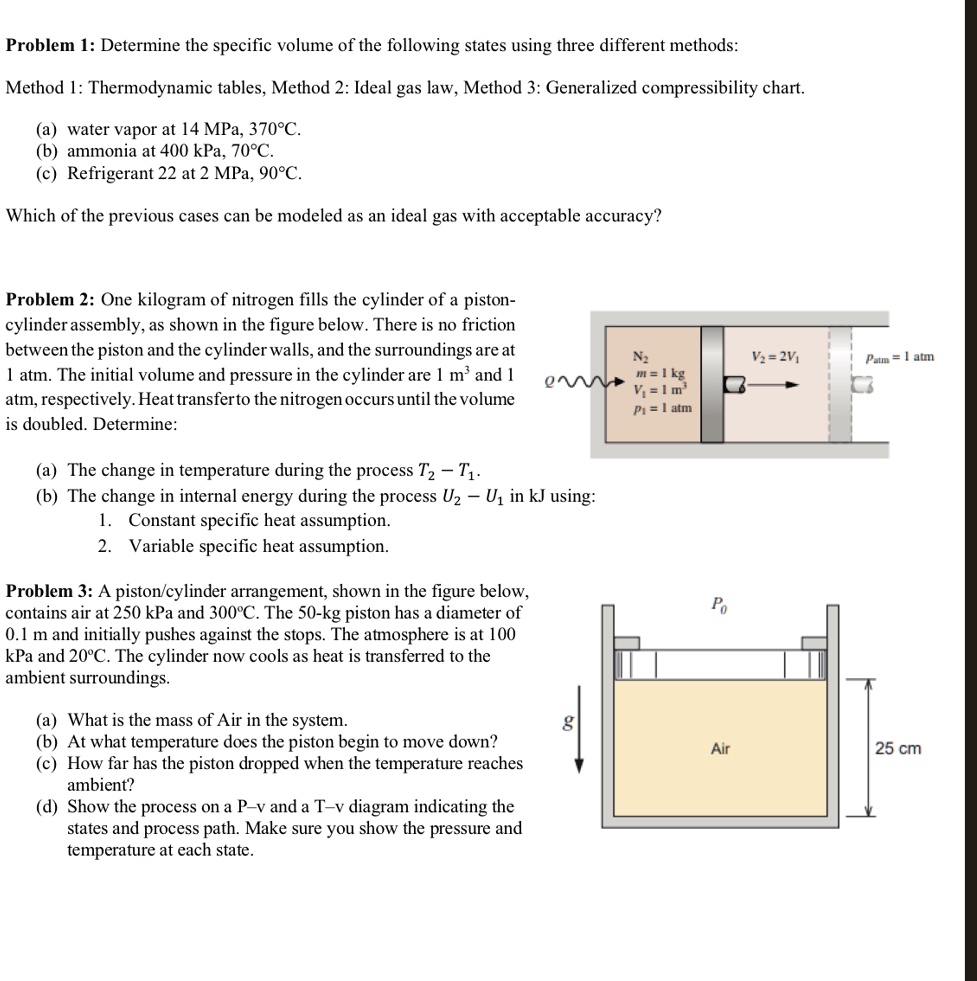
Problem 2: One kilogram of nitrogen fills the cylinder of a piston-
cylinder assembly, as shown in the figure below. There is no friction
between the piston and the cylinder walls, and the surroundings are at
1 atm. The initial volume and pressure in the cylinder are 1 m³ and 1
atm, respectively. Heat transfer to the nitrogen occurs until the volume
is doubled. Determine:
(a) The change in temperature during the process T2 - T1.
(b) The change in internal energy during the process U2 U₁ in kJ using:
1. Constant specific heat assumption.
2. Variable specific heat assumption.
Problem 3: A piston/cylinder arrangement, shown in the figure below,
contains air at 250 kPa and 300°C. The 50-kg piston has a diameter of
0.1 m and initially pushes against the stops. The atmosphere is at 100
kPa and 20°C. The cylinder now cools as heat is transferred to the
ambient surroundings.
(a) What is the mass of Air in the system.
(b) At what temperature does the piston begin to move down?
(c) How far has the piston dropped when the temperature reaches
ambient?
(d) Show the process on a P-v and a T-v diagram indicating the
states and process path. Make sure you show the pressure and
temperature at each state.
Po
g
Air
25 cm