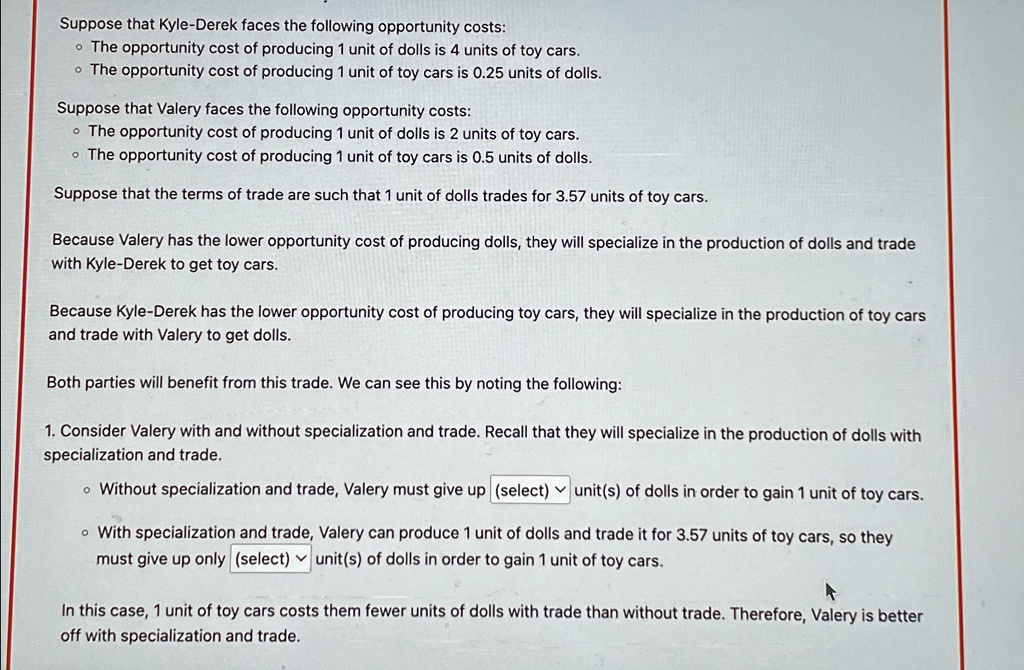
Suppose that Kyle-Derek faces the following opportunity costs:
• The opportunity cost of producing 1 unit of dolls is 4 units of toy cars.
• The opportunity cost of producing 1 unit of toy cars is 0.25 units of dolls.
Suppose that Valery faces the following opportunity costs:
• The opportunity cost of producing 1 unit of dolls is 2 units of toy cars.
• The opportunity cost of producing 1 unit of toy cars is 0.5 units of dolls.
Suppose that the terms of trade are such that 1 unit of dolls trades for 3.57 units of toy cars.
Because Valery has the lower opportunity cost of producing dolls, they will specialize in the production of dolls and trade
with Kyle-Derek to get toy cars.
Because Kyle-Derek has the lower opportunity cost of producing toy cars, they will specialize in the production of toy cars
and trade with Valery to get dolls.
Both parties will benefit from this trade. We can see this by noting the following:
1. Consider Valery with and without specialization and trade. Recall that they will specialize in the production of dolls with
specialization and trade.
• Without specialization and trade, Valery must give up (select) unit(s) of dolls in order to gain 1 unit of toy cars.
• With specialization and trade, Valery can produce 1 unit of dolls and trade it for 3.57 units of toy cars, so they
must give up only (select) unit(s) of dolls in order to gain 1 unit of toy cars.
In this case, 1 unit of toy cars costs them fewer units of dolls with trade than without trade. Therefore, Valery is better
off with specialization and trade.