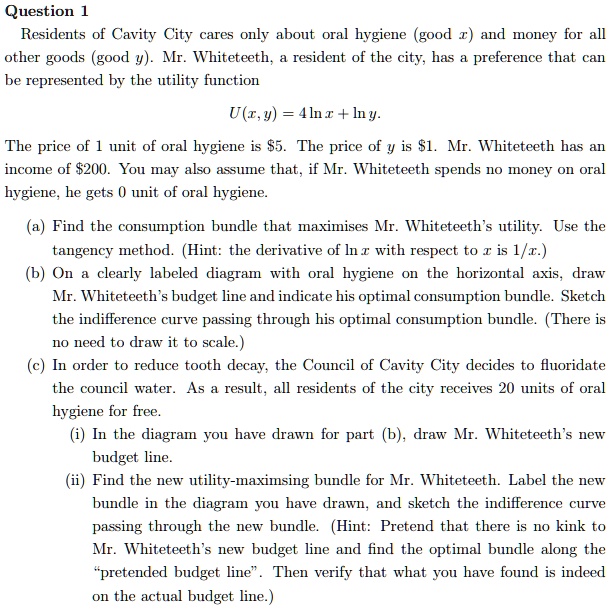
Question 1
Residents of Cavity City cares only about oral hygiene (good z) and money for all
other goods (good y). Mr. Whiteteeth, a resident of the city, has a preference that can
be represented by the utility function
$U(x, y) = 4 \ln x + \ln y$.
The price of 1 unit of oral hygiene is $5. The price of y is $1. Mr. Whiteteeth has an
income of $200. You may also assume that, if Mr. Whiteteeth spends no money on oral
hygiene, he gets 0 unit of oral hygiene.
(a) Find the consumption bundle that maximises Mr. Whiteteeth's utility. Use the
tangency method. (Hint: the derivative of $\ln z$ with respect to z is 1/x.)
(b) On a clearly labeled diagram with oral hygiene on the horizontal axis, draw
Mr. Whiteteeth's budget line and indicate his optimal consumption bundle. Sketch
the indifference curve passing through his optimal consumption bundle. (There is
no need to draw it to scale.)
(c) In order to reduce tooth decay, the Council of Cavity City decides to fluoridate
the council water. As a result, all residents of the city receives 20 units of oral
hygiene for free.
(i) In the diagram you have drawn for part (b), draw Mr. Whiteteeth's new
budget line.
(ii) Find the new utility-maximsing bundle for Mr. Whiteteeth. Label the new
bundle in the diagram you have drawn, and sketch the indifference curve
passing through the new bundle. (Hint: Pretend that there is no kink to
Mr. Whiteteeth's new budget line and find the optimal bundle along the
"pretended budget line". Then verify that what you have found is indeed
on the actual budget line.)