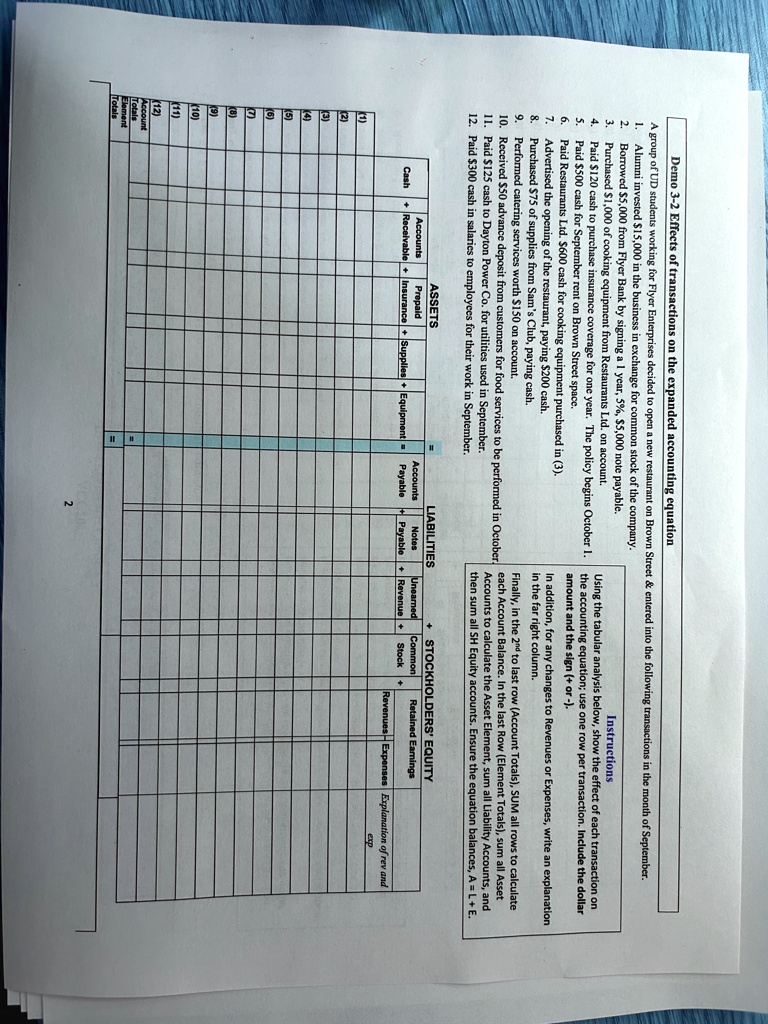
Demo 3-2 Effects of transactions on the expanded accounting equation
A group of UD students working for Flyer Enterprises decided to open a new restaurant on Brown Street & entered into the following transactions in the month of September.
1. Alumni invested $15,000 in the business in exchange for common stock of the company.
2. Borrowed $5,000 from Flyer Bank by signing a 1 year, 5%, $5,000 note payable.
3. Purchased $1,000 of cooking equipment from Restaurants Ltd. on account.
4. Paid $120 cash to purchase insurance coverage for one year. The policy begins October 1.
5. Paid $500 cash for September rent on Brown Street space.
6. Paid Restaurants Ltd. $600 cash for cooking equipment purchased in (3).
7. Advertised the opening of the restaurant, paying $200 cash.
8. Purchased $75 of supplies from Sam's Club, paying cash.
9. Performed catering services worth $150 on account.
Instructions
Using the tabular analysis below, show the effect of each transaction on
the accounting equation; use one row per transaction. Include the dollar
amount and the sign (+ or -).
In addition, for any changes to Revenues or Expenses, write an explanation
in the far right column.
Finally, in the 2nd to last row (Account Totals), SUM all rows to calculate
Accounts to calculate the Asset Element, sum all Liability Accounts, and
then sum all SH Equity accounts. Ensure the equation balances, A = L + E.
10. Received $50 advance deposit from customers for food services to be performed in October, each Account Balance. In the last Row (Element Totals), sum all Asset
11. Paid $125 cash to Dayton Power Co. for utilities used in September.
12. Paid $300 cash in salaries to employees for their work in September.
(1)
(2)
(3)
(4)
(5)
(6)
(7)
(8)
(9)
(10)
(11)
(12)
Account
Totals
Element
Totals
Accounts
ASSETS
Prepaid
LIABILITIES
STOCKHOLDERS' EQUITY
Cash
Receivable+ Insurance + Supplies + Equipment = Payable
Accounts Notes
Payable
Unearned Common
Revenue + Stock
Retained Earnings
Revenues Expenses Explanation of rev and
exp