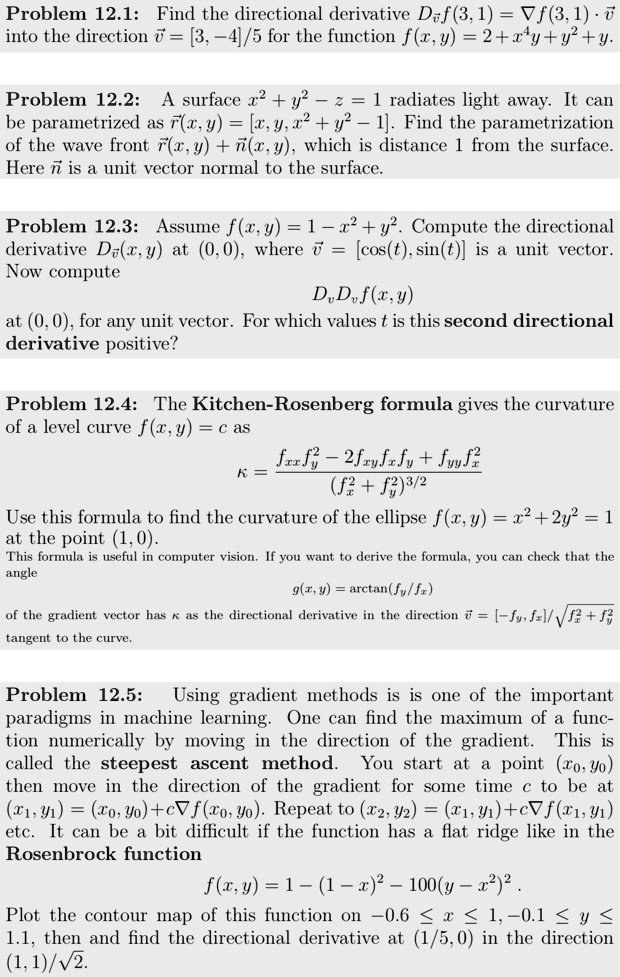
Problem 12.1: Find the directional derivative Df3.1 = Vf3.1 into the direction = [3, -4]/5 for the function f(x,y) = 2 + x^4y + y^2
Problem 12.2: A surface x^2 + y^2 - z = 1 radiates light away. It can be parametrized as r = [x, y, x+y-1]. Find the parametrization of the wave front r(x,y) + n(x,y), which is distance 1 from the surface. Here n is a unit vector normal to the surface.
Problem 12.3: Assume f(x,y) = 1 - x^2 + y^2. Compute the directional derivative Df(x,y) at (0,0), where = [cos(t), sin(t)] is a unit vector. Now compute D^2f(x,y) at (0,0), for any unit vector. For which values t is this second directional derivative positive?
Problem 12.4: The Kitchen-Rosenberg formula gives the curvature of a level curve f(x,y) = c as
k = (x^2*f_xx + 2xy*f_xy + y^2*f_yy) / (f_x^2 + f_y^2)^(3/2)
Use this formula to find the curvature of the ellipse f(x,y) = 2 + 2y^2 = 1 at the point (1,0). This formula is useful in computer vision. If you want to derive the formula, you can check that the angle g(x,y) = arctan(f_y/f_x) of the gradient vector has k as the directional derivative in the direction = [-f_y, f_x]/(f_x + f_y) tangent to the curve.
Problem 12.5: Using gradient methods is one of the important paradigms in machine learning. One can find the maximum of a function numerically by moving in the direction of the gradient. This is called the steepest ascent method. You start at a point (x0, y0) then move in the direction of the gradient for some time c to be at (x1, y1) = (x0, y0) + cVf(x0, y0). Repeat to (x2, y2) = (x1, y1) + cVf(x1, y1) etc. It can be a bit difficult if the function has a flat ridge like in the Rosenbrock function f(x,y) = 1 - (1-x)^2 - 100(y-x^2).
Plot the contour map of this function on -0.6 ≤ x ≤ 1, -0.1 ≤ y ≤ 1.1, then find the directional derivative at (1/5,0) in the direction (1, 1)/√2.