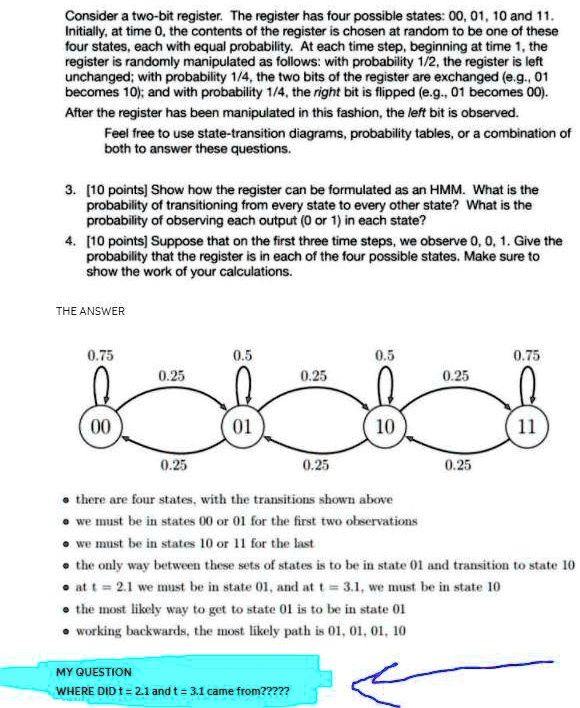
Consider a two-bit register. The register has four possible states: 00, 01, 10, and 11. Initially, at time 0, the contents of the register are chosen at random to be one of these four states, each with equal probability. At each time step, beginning at time 1, the register is randomly manipulated as follows: with probability 1/2, the register is left unchanged; with probability 1/4, the two bits of the register are exchanged (e.g. 01 becomes 10); and with probability 1/4, the right bit is flipped (e.g. 01 becomes 00).
Feel free to use state-transition diagrams, probability tables, or a combination of both to answer these questions.
3. [10 points] Show how the register can be formulated as an HMM. What is the probability of transitioning from every state to every other state? What is the probability of observing each output (0 or 1) in each state?
4. [10 points] Suppose that on the first three time steps, we observe 0, 0, 1. Give the probability that the register is in each of the four possible states. Make sure to show the work of your calculations.
THE ANSWER:
0.75
0.5
0.5
0.75
0.25
0.25
0.25
00
0.25
0.25
0.25
Since there are four states, with the transitions shown above, we must be in states 00 or 01 for the first two observations. So, we must be in states 10 or 11 for the last observation. The only way between these sets of states is to be in state 01 and transition to state 10. So, at t=2.1 we must be in state 01, and at t=3.1 we must be in state 10. The most likely way to get to state 01 is to be in state 01. Working backwards, the most likely path is 01, 01, 01, 10.
MY QUESTION: WHERE DID t=2.1 and t=3.1 come from?????