Ace - AI Tutor
Ask Our Educators
Textbooks
My Library
Flashcards
Scribe - AI Notes
Notes & Exams
Download App
bradley sosa

bradley s.

Divider

Questions asked

BEST MATCH

DNA replication of the chromosome always leads to Increase of the copy number of plasmids Decrease of the copy number of plasmids Increase of the copy number of transposons None of the above are correct

View Answer
divider
BEST MATCH

Which is the best description of the setting? The design of the study The participants in the study Questions that are linked to the purpose Where the data are collected

View Answer
divider
BEST MATCH

The motion of a particle is defined by the relation $x = \frac{t}{t^2 - 1}$, where $x$ and $t$ are expressed in feet and seconds, respectively. The total distance traveled by the particle from $t = 1$ to $t = 3$ s.

View Answer
divider
BEST MATCH

To improve your productivity, simplify the following expression using the distributive property: (x + 4)(x - 9)

View Answer
divider
BEST MATCH

Question 9 of 20 This test: 20 point(s) possible This question: 1 point(s) possible Submit test The mean score on a Statistics exam is 80 points, with a standard deviation of 4 points. Apply Chebychev's Theorem to the data using $k = 2$. Interpret the results. At least % of the exam scores fall between and (Simplify your answers.)

View Answer
divider
BEST MATCH

Use the t-table in your book. What is the t* value if there are 8 degrees of freedom and we want to create a 95% confidence interval? What is the t* value if there are 4 degrees of freedom and we want to create a 99% confidence interval? What is the t* value if there are 26 degrees of freedom and we want to create a 90% confidence interval? What is the t* value if there are more than 120 degrees of freedom and we want to create a 95% confidence interval?

View Answer
divider
BEST MATCH

11. Determine the undamped acceleration response spectrum $S_a(T)$ under the ground acceleration pulse shown for $0 \le T \le 2$ s. m $\ddot{u}_g$ $u(0) = \dot{u}(0) = 0$ k $\ddot{u}_{go}$ $\ddot{u}_g$ t (sec) 0 1 Hint 1. Try $u_p = G$ for particular solution, where G is an arbitrary constant. 2. When $T_n \le 2$ s, maximum response occurs during the forced vibration phase. Answer $S_a(0) = 2\ddot{u}_{go}$; $S_a(2) = 2\ddot{u}_{go}$; $S_a(4) = \ddot{u}_{go}$

View Answer
divider
BEST MATCH

Find the equation of hyperbola with one vertex is A(0,3) and one asymptote is defined by y=2x

View Answer
divider
BEST MATCH

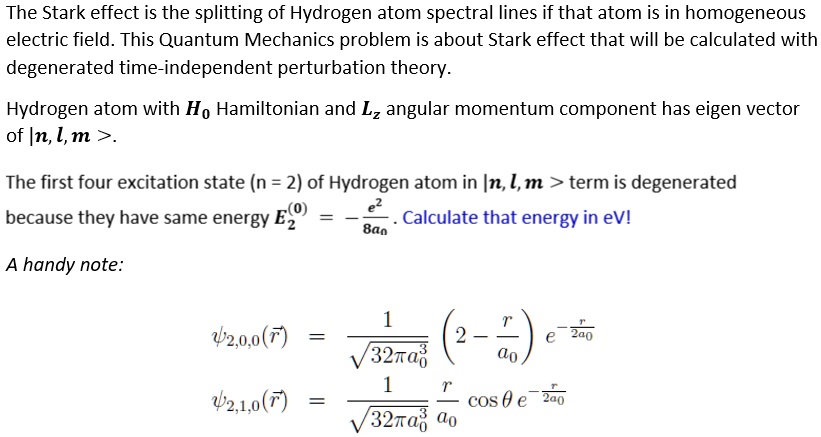
The Stark effect is the splitting of Hydrogen atom spectral lines if that atom is in homogeneous electric field. This Quantum Mechanics problem is about Stark effect that will be calculated with degenerated time-independent perturbation theory. Hydrogen atom with $H_0$ Hamiltonian and $L_z$ angular momentum component has eigen vector of $|n, l, m >$. The first four excitation state (n = 2) of Hydrogen atom in $|n, l, m >$ term is degenerated because they have same energy $E_2^{(0)} = -\frac{e^2}{8a_0}$. Calculate that energy in eV! A handy note: $\psi_{2,0,0}(\vec{r}) = \frac{1}{\sqrt{32\pi a_0^3}} \left(2 - \frac{r}{a_0}\right) e^{-\frac{r}{2a_0}}$ $\psi_{2,1,0}(\vec{r}) = \frac{1}{\sqrt{32\pi a_0^3}} \frac{r}{a_0} \cos\theta e^{-\frac{r}{2a_0}}$
View Answer
divider
BEST MATCH

[3] Write down the correct matrix (fill in the blanks), given the E.R.O's: \begin{bmatrix} 1 & 3 & -1 & 6 \\ -4 & 0 & 1 & 3 \\ 3 & 1 & 3 & 11 \end{bmatrix} \quad \begin{aligned} R_2' &= R_2 + 4R_1 \\ R_3' &= R_3 - 3R_1 \end{aligned} \rightarrow \begin{bmatrix} \Box & \Box & \Box & \Box \\ \Box & \Box & \Box & \Box \\ \Box & \Box & \Box & \Box \end{bmatrix}

View Answer
divider