Clay
Pivot
Rod
Clay
Clay
Top View
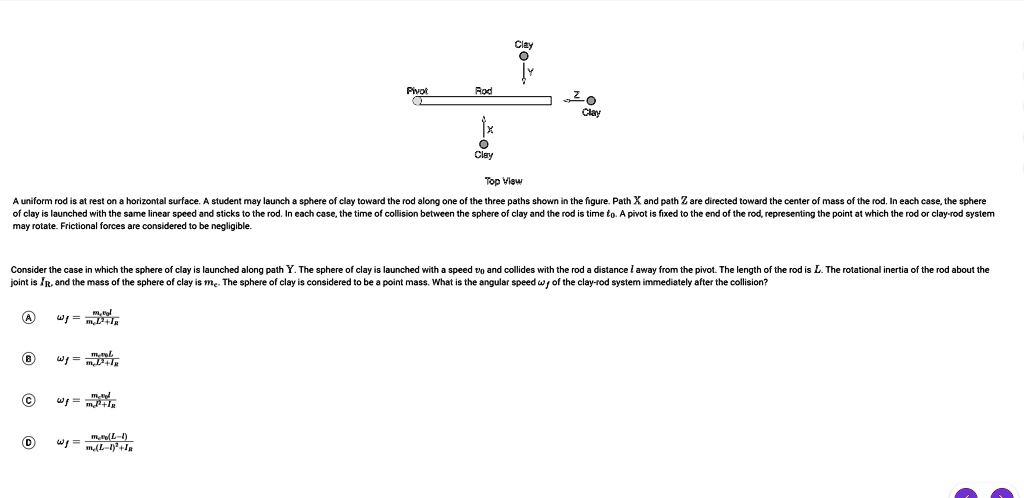
A uniform rod is at rest on a horizontal surface. A student may launch a sphere of clay toward the rod along one of the three paths shown in the figure. Path X and path Z are directed toward the center of mass of the rod. In each case, the sphere
of clay is launched with the same linear speed and sticks to the rod. In each case, the time of collision between the sphere of clay and the rod is time $t_0$. A pivot is fixed to the end of the rod, representing the point at which the rod or clay-rod system
may rotate. Frictional forces are considered to be negligible.
Consider the case in which the sphere of clay is launched along path Y. The sphere of clay is launched with a speed $v_0$ and collides with the rod a distance $l$ away from the pivot. The length of the rod is $L$. The rotational inertia of the rod about the
joint is $I_r$, and the mass of the sphere of clay is $m_c$. The sphere of clay is considered to be a point mass. What is the angular speed $\omega_f$ of the clay-rod system immediately after the collision?
A
$\omega_f = \frac{m_c v_0 l}{m_c l^2 + I_r}$
B
$\omega_f = \frac{m_c v_0 l}{m_c L^2 + I_r}$
C
$\omega_f = \frac{m_c v_0 l}{m_c l + I_r}$
D
$\omega_f = \frac{m_c v_0 (L-l)}{m_c (L-l)^2 + I_r}$