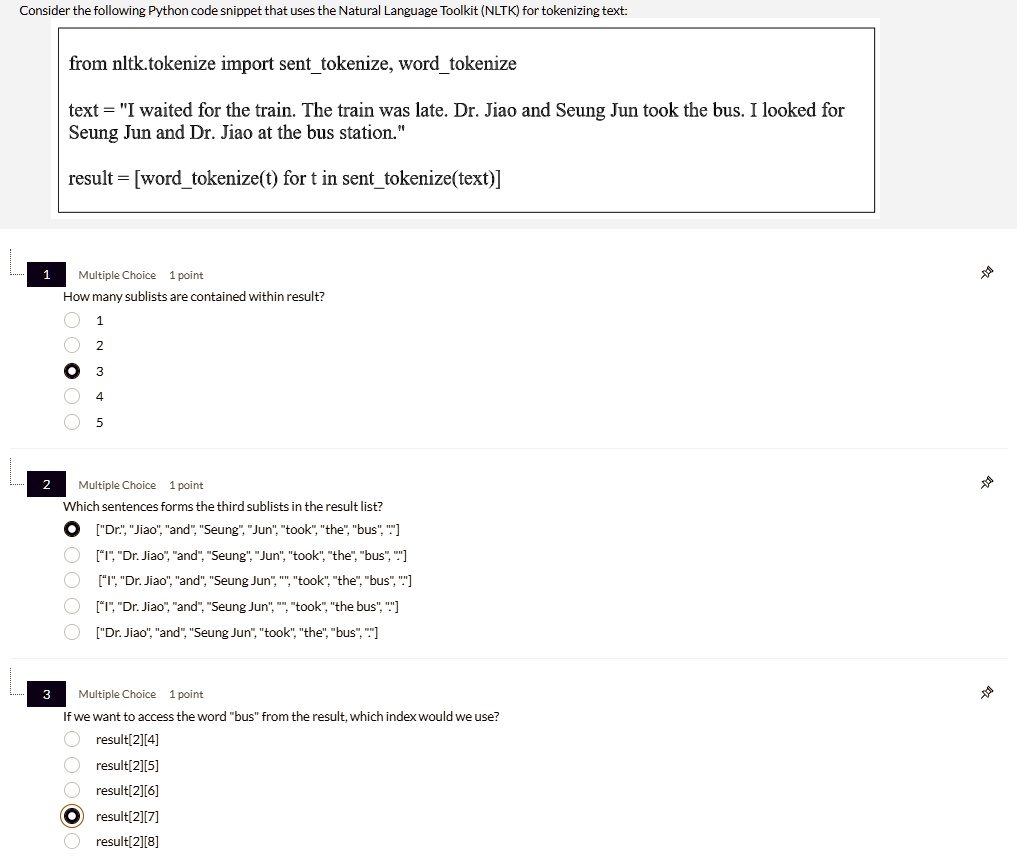
Consider the following Python code snippet that uses the Natural Language Toolkit (NLTK) for tokenizing text:
from nltk.tokenize import sent_tokenize, word_tokenize
text = "I waited for the train. The train was late. Dr. Jiao and Seung Jun took the bus. I looked for
Seung Jun and Dr. Jiao at the bus station."
result = [word_tokenize(t) for t in sent_tokenize(text)]
How many sublists are contained within result?
Which sentences forms the third sublists in the result list?
["Dr.", "Jiao", "and", "Seung", "Jun", "took", "the", "bus", ""]
["I", "Dr. Jiao", "and", "Seung", "Jun", "took", "the", "bus", "."]
["I", "Dr. Jiao", "and", "Seung Jun", "", "took", "the", "bus", "."]
["I", "Dr. Jiao", "and", "Seung Jun", "", "took", "the bus", "."]
["Dr. Jiao", "and", "Seung Jun", "took", "the", "bus", "."]
If we want to access the word "bus" from the result, which index would we use?
result[2][4]
result[2][5]
result[2][6]
result[2][7]
result[2][8]