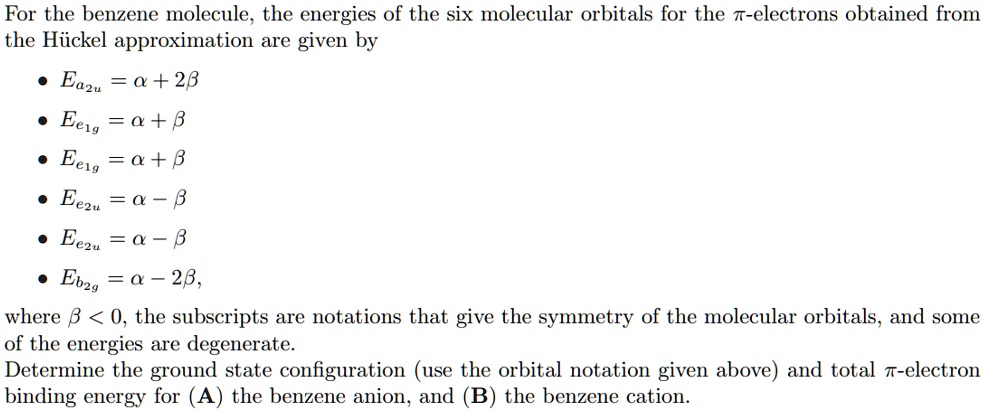
For the benzene molecule, the energies of the six molecular orbitals for the \(\pi\)-electrons obtained from the Hückel approximation are given by
\(\bullet E_{a_{2u}} = \alpha + 2\beta\)
\(\bullet E_{e_{1g}} = \alpha + \beta\)
\(\bullet E_{e_{1g}} = \alpha + \beta\)
\(\bullet E_{e_{2u}} = \alpha - \beta\)
\(\bullet E_{e_{2u}} = \alpha - \beta\)
\(\bullet E_{b_{2g}} = \alpha - 2\beta,\)
where \(\beta < 0\), the subscripts are notations that give the symmetry of the molecular orbitals, and some of the energies are degenerate.
Determine the ground state configuration (use the orbital notation given above) and total \(\pi\)-electron binding energy for (A) the benzene anion, and (B) the benzene cation.