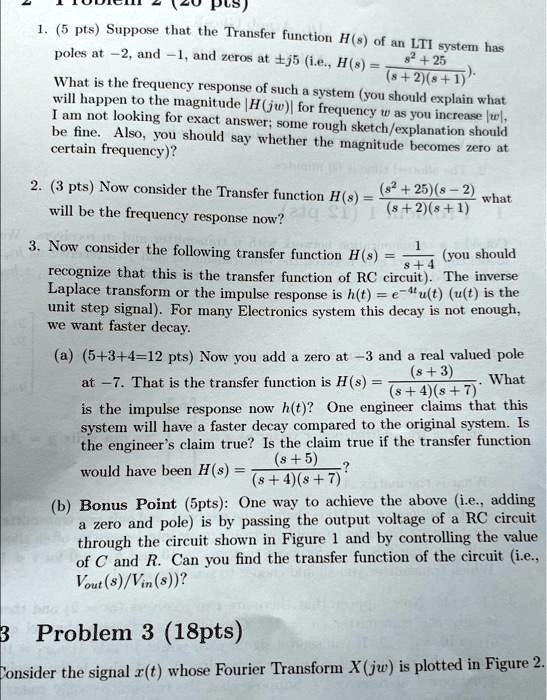
1. (5 pts) Suppose that the Transfer function H(s) of an LTI system has
poles at -2, and -1, and zeros at ±j5 (i.e., $H(s) = \frac{s^2 + 25}{(s+2)(s+1)}$)
What is the frequency response of such a system (you should explain what
will happen to the magnitude $|H(jw)|$ for frequency $w$ as you increase $w$,
I am not looking for exact answer; some rough sketch/explanation should
be fine. Also, you should say whether the magnitude becomes zero at
certain frequency)?
2. (3 pts) Now consider the Transfer function $H(s) = \frac{(s^2 + 25)(s - 2)}{(s+2)(s+1)}$ what
will be the frequency response now?
3. Now consider the following transfer function $H(s) = \frac{1}{s+4}$ (you should
recognize that this is the transfer function of RC circuit). The inverse
Laplace transform or the impulse response is $h(t) = e^{-4t}u(t)$ ($u(t)$ is the
unit step signal). For many Electronics system this decay is not enough,
we want faster decay.
(a) (5+3+4=12 pts) Now you add a zero at -3 and a real valued pole
at -7. That is the transfer function is $H(s) = \frac{(s+3)}{(s+4)(s+7)}$. What
is the impulse response now $h(t)$? One engineer claims that this
system will have a faster decay compared to the original system. Is
the engineer's claim true? Is the claim true if the transfer function
would have been $H(s) = \frac{(s+5)}{(s+4)(s+7)}$?
(b) Bonus Point (5pts): One way to achieve the above (i.e., adding
a zero and pole) is by passing the output voltage of a RC circuit
through the circuit shown in Figure 1 and by controlling the value
of C and R. Can you find the transfer function of the circuit (i.e.,
$V_{out}(s)/V_{in}(s)$)?
3 Problem 3 (18pts)
Consider the signal $x(t)$ whose Fourier Transform $X(jw)$ is plotted in Figure 2.