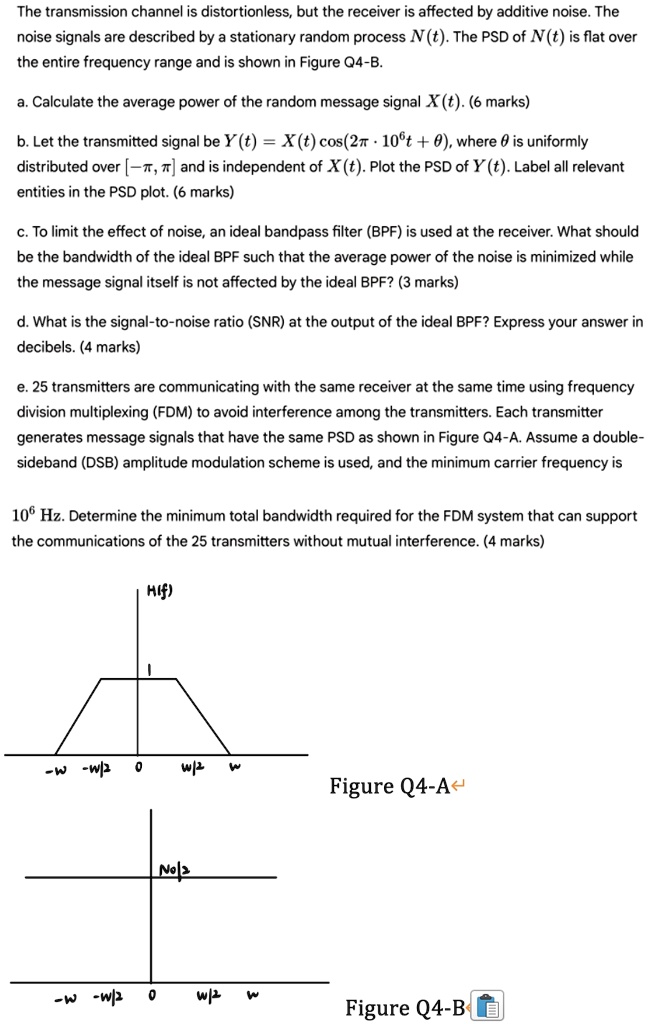
The transmission channel is distortionless, but the receiver is affected by additive noise. The noise signals are described by a stationary random process $N(t)$. The PSD of $N(t)$ is flat over the entire frequency range and is shown in Figure Q4-B.
a. Calculate the average power of the random message signal $X(t)$. (6 marks)
b. Let the transmitted signal be $Y(t) = X(t) \cos(2\pi \cdot 10^6 t + \theta)$, where $\theta$ is uniformly distributed over $[-\pi, \pi]$ and is independent of $X(t)$. Plot the PSD of $Y(t)$. Label all relevant entities in the PSD plot. (6 marks)
c. To limit the effect of noise, an ideal bandpass filter (BPF) is used at the receiver. What should be the bandwidth of the ideal BPF such that the average power of the noise is minimized while the message signal itself is not affected by the ideal BPF? (3 marks)
d. What is the signal-to-noise ratio (SNR) at the output of the ideal BPF? Express your answer in decibels. (4 marks)
e. 25 transmitters are communicating with the same receiver at the same time using frequency division multiplexing (FDM) to avoid interference among the transmitters. Each transmitter generates message signals that have the same PSD as shown in Figure Q4-A. Assume a double-sideband (DSB) amplitude modulation scheme is used, and the minimum carrier frequency is $10^6$ Hz. Determine the minimum total bandwidth required for the FDM system that can support the communications of the 25 transmitters without mutual interference. (4 marks)
$H(f)$
$-w$ $-w/2$ $0$ $w/2$ $w$
Figure Q4-A
$-w$ $-w/2$ $0$ $w/2$ $w$
$N_0/2$
Figure Q4-B