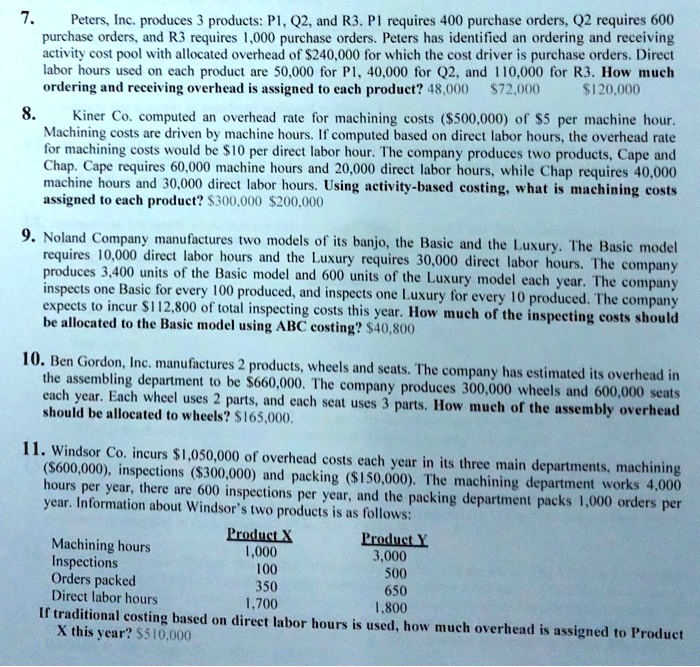
7. Peters, Inc. produces 3 products: P1, Q2, and R3. P1 requires 400 purchase orders, Q2 requires 600 purchase orders, and R3 requires 1,000 purchase orders. Peters has identified an ordering and receiving activity cost pool with allocated overhead of $240,000 for which the cost driver is purchase orders. Direct labor hours used on each product are 50,000 for P1, 40,000 for Q2, and 110,000 for R3. How much ordering and receiving overhead is assigned to each product? $48,000 $72,000 $120,000
8. Kiner Co. computed an overhead rate for machining costs ($500,000) of $5 per machine hour. Machining costs are driven by machine hours. If computed based on direct labor hours, the overhead rate for machining costs would be $10 per direct labor hour. The company produces two products, Cape and Chap. Cape requires 60,000 machine hours and 20,000 direct labor hours, while Chap requires 40,000 machine hours and 30,000 direct labor hours. Using activity-based costing, what is machining costs assigned to each product? $300,000 $200,000
9. Noland Company manufactures two models of its banjo, the Basic and the Luxury. The Basic model requires 10,000 direct labor hours and the Luxury requires 30,000 direct labor hours. The company produces 3,400 units of the Basic model and 600 units of the Luxury model each year. The company inspects one Basic for every 100 produced, and inspects one Luxury for every 10 produced. The company expects to incur $112,800 of total inspecting costs this year. How much of the inspecting costs should be allocated to the Basic model using ABC costing? $40,800
10. Ben Gordon, Inc. manufactures 2 products, wheels and seats. The company has estimated its overhead in the assembling department to be $660,000. The company produces 300,000 wheels and 600,000 seats each year. Each wheel uses 2 parts, and each seat uses 3 parts. How much of the assembly overhead should be allocated to wheels? $165,000.
11. Windsor Co. incurs $1,050,000 of overhead costs each year in its three main departments: machining ($600,000), inspections ($300,000), and packing ($150,000). The machining department works 4,000 hours per year, there are 600 inspections per year, and the packing department packs 1,000 orders per year. Information about Windsor's two products is as follows:
Product X:
- Machining hours: 1,000
- Inspections: 3,000
- Orders packed: 500
- Direct labor hours: 650
Product Y:
- Machining hours: 1,700
- Inspections: 1,800
- Orders packed: 350
- Direct labor hours: 1,800
If traditional costing based on direct labor hours is used, how much overhead is assigned to Product X this year? $510,000