Inflammation requires many individual components of the immune system to act in concert in order to allow neutrophils to phagocytize microbes at the site of infection.
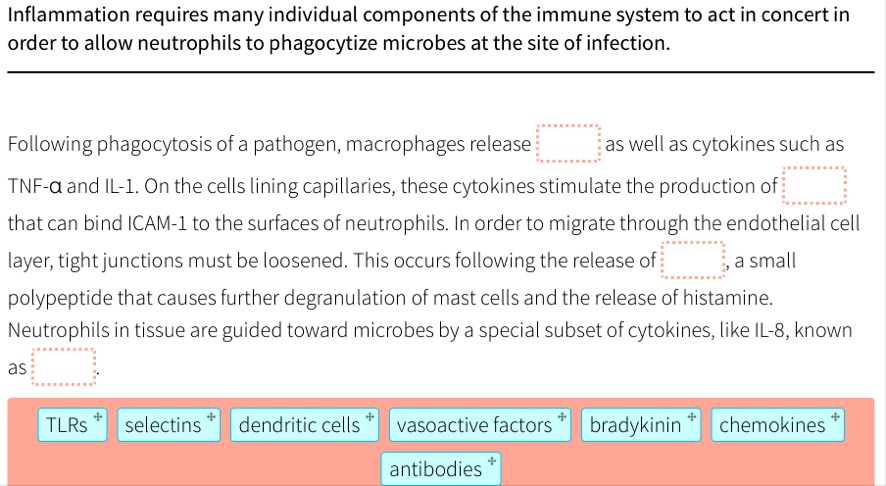
Following phagocytosis of a pathogen, macrophages release ◻ as well as cytokines such as TNF-a and IL-1. On the cells lining capillaries, these cytokines stimulate the production of
q, that can bind ICAM-1 to the surfaces of neutrophils. In order to migrate through the endothelial cell layer, tight junctions must be loosened. This occurs following the release of q, , a small polypeptide that causes further degranulation of mast cells and the release of histamine. Neutrophils in tissue are guided toward microbes by a special subset of cytokines, like IL-8, known as q,
TLRs * selectins *
dendritic cells *
vasoactive factors * ◻
antibodies *