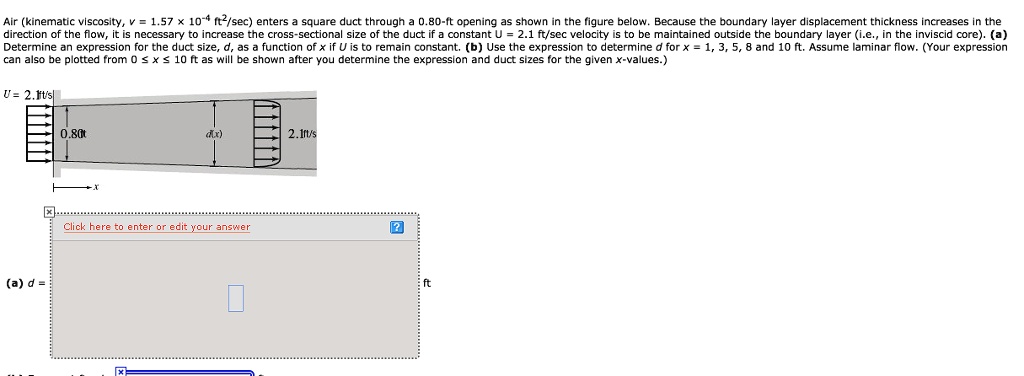
Air (kinematic viscosity, $v = 1.57 \times 10^{-4} ft^2/sec$) enters a square duct through a 0.80-ft opening as shown in the figure below. Because the boundary layer displacement thickness increases in the direction of the flow, it is necessary to increase the cross-sectional size of the duct if a constant $U = 2.1 ft/sec$ velocity is to be maintained outside the boundary layer (i.e., in the inviscid core). (a) Determine an expression for the duct size, $d$, as a function of $x$ if $U$ is to remain constant. (b) Use the expression to determine $d$ for $x = 1, 3, 5, 8$ and 10 ft. Assume laminar flow. (Your expression can also be plotted from $0 \leq x \leq 10$ ft as will be shown after you determine the expression and duct sizes for the given $x$-values.)
$U = 2.1 ft/s$