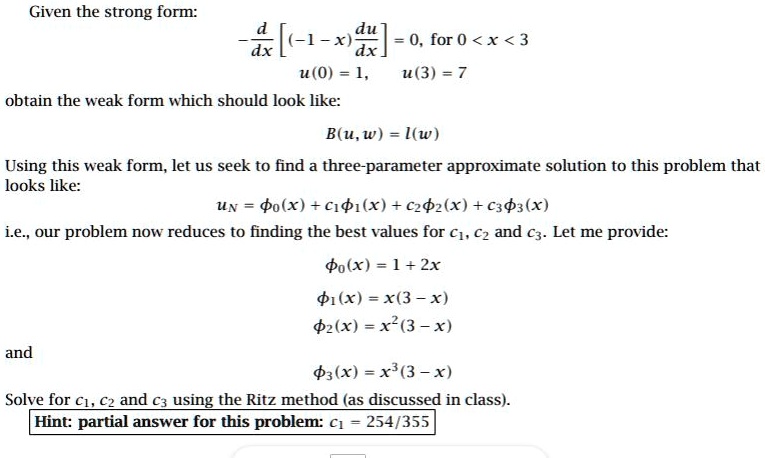
Given the strong form:
\frac{d}{dx}\left[(-1-x)\frac{du}{dx}\right] = 0, for 0 < x < 3
u(0) = 1, \quad u(3) = 7
obtain the weak form which should look like:
B(u, w) = l(w)
Using this weak form, let us seek to find a three-parameter approximate solution to this problem that
looks like:
u_N = \phi_0(x) + c_1\phi_1(x) + c_2\phi_2(x) + c_3\phi_3(x)
i.e., our problem now reduces to finding the best values for $c_1, c_2$ and $c_3$. Let me provide:
$\phi_0(x) = 1 + 2x
\phi_1(x) = x(3 - x)
\phi_2(x) = x^2(3 - x)
\phi_3(x) = x^3(3 - x)$
and
Solve for $c_1, c_2$ and $c_3$ using the Ritz method (as discussed in class).
Hint: partial answer for this problem: $c_1 = \frac{254}{355}$