Ace - AI Tutor
Ask Our Educators
Textbooks
My Library
Flashcards
Scribe - AI Notes
Notes & Exams
Download App
brenda valdez

brenda v.

Divider

Questions asked

BEST MATCH

What is the SSI rate for the semiannual period What is the C-section rate for the semiannual period What is the gross mortality rate for the semiannual period

View Answer
divider
BEST MATCH

in what type of environment would one expect to find bacteria capable of carrying out the decomposition of cysteine? what are the physicochemical conditions of this environment?

View Answer
divider
BEST MATCH

When a player always prefers one strategy regardless of what his or her opponent chooses, we say it is a ______ strategy. a. noncompetitive b. dominant c. tit-for-tat d. backward induction e. Nash equilibrium

View Answer
divider
BEST MATCH

Restricting access of users to specific portions of the systems as well as specific tasks, is Group of answer choices Threat monitoring Identification Authorization Authentication

View Answer
divider
BEST MATCH

What is the value of t crit used in a small sample 99% confidence interval for the mean when the sample size is n = 25? 90% confidence interval for the mean when the sample size is n = 30? 95% confidence interval for the mean when the sample size is n = 15? 99% confidence interval for the mean when the sample size is n = 27?

View Answer
divider
BEST MATCH

What prosocial development factors are associated with Selman and Erikson's theories of development?

View Answer
divider
BEST MATCH

give some possible reasons for the source of these silly "definitions"

View Answer
divider
BEST MATCH

3. Solving the wave equation. An infinite string is stretched along the x-axis and is given an initial displacement described by a function $f(x)$. It is then free to vibrate. The displacement $u(x, t)$ at a time $t > 0$ and at a point $x$ on the string is described by the wave equation\\ $\frac{\partial^2 u}{\partial t^2} = \frac{\partial^2 u}{\partial x^2}$.\\One often includes physical constants in the equation, e.g, the speed of the wave, but these are suppressed to keep things simple. Assume that $u(x, 0) = f(x)$ and $u_t(x, 0) = 0$ (zero initial velocity) and use the Fourier transform to show that\\$u(x, t) = \frac{1}{2}(f(x + t) + f(x - t)).$

View Answer
divider
BEST MATCH

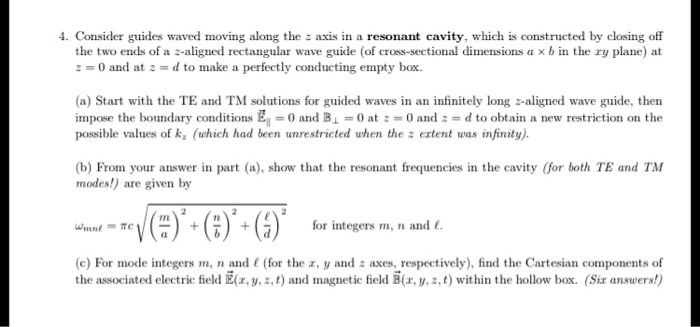
4. Consider guides waved moving along the z axis in a resonant cavity, which is constructed by closing off the two ends of a z-aligned rectangular wave guide (of cross-sectional dimensions a \times b in the xy plane) at z = 0 and at z = d to make a perfectly conducting empty box. (a) Start with the TE and TM solutions for guided waves in an infinitely long z-aligned wave guide, then impose the boundary conditions \(\vec{E}_{\parallel} = 0\) and \(\vec{B}_{\perp} = 0\) at z = 0 and z = d to obtain a new restriction on the possible values of \(k_z\) (which had been unrestricted when the z extent was infinity). (b) From your answer in part (a), show that the resonant frequencies in the cavity (for both TE and TM modes!) are given by \(\omega_{mnl} = \pi c \sqrt{\left(\frac{m}{a}\right)^2 + \left(\frac{n}{b}\right)^2 + \left(\frac{l}{d}\right)^2}\) for integers m, n and l. (c) For mode integers m, n and l (for the x, y and z axes, respectively), find the Cartesian components of the associated electric field \(\vec{E}(x, y, z, t)\) and magnetic field \(\vec{B}(x, y, z, t)\) within the hollow box. (Six answers!)
View Answer
divider
BEST MATCH

$ \newline MC \newline ATC \newline p6 \newline p5 \newline p4 \newline p3 \newline p2 \newline p1 \newline D \newline Output \newline q1 q2 \newline q3 q4 \newline MR

View Answer
divider