Questions asked
Classify each aqueous solution as acidic, basic, or neutral at 25 °C. Acidic Basic Neutral Answer Bank pH = 12.26 [H+] = 1.0 x 10⁻⁷ [OH-] = 8.4 x 10⁻⁴ [OH-] = 5.0 x 10⁻¹⁰ [H+] = 6.6 x 10⁻⁶
You note a population of T cells that contain primarily high-affinity IL-2R on their cell surfaces. Based on that observation, what can you predict about the activation state of the cells? They have not been exposed to antigen. T cells do not express IL-2R, so we cannot determine their activation state using these data. This cell population has been exposed to IL-2 and is active. They have been exposed to antigen but not IL-2. None of the answers are correct.
Suppose a consumer values a certain 19-inch television set at $150, and the seller is unwilling to sell the set for less than $200. What price will lead to an efficient transaction between the potential buyer and seller? Group of answer choices Any price greater than or equal to $150 and less than or equal to $200 No price will lead to an efficient transaction Any price greater than $0 and less than $150 A price of $0 Any price greater than $200
Problem 5: (8% of Assignment Value) Consider a person whose eyes have a fully accommodated power of 56.5 D. Assume the distance from the lens to the retina is a fixed 2.00 cm. Randomized Variables P = 56.5 D
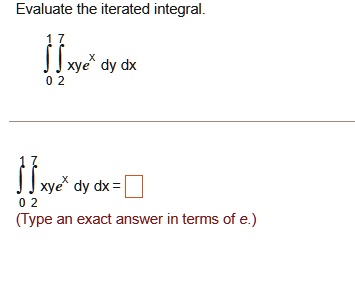
Evaluate the iterated integral.\\ $\int_0^1 \int_2^7 xye^x \, dy \, dx$ \\ $\int_0^1 \int_2^7 xye^x \, dy \, dx = $\boxed{}$ \\ (Type an exact answer in terms of e.)
2x² - 13x + 20 = 0
7) An object has as initial temperature of $T_0$ and is placed into a surrounding medium with a lower temperature C. The temperature T of the cooling object drops at a rate that is proportional to the difference $T - C$. That is: $\frac{dT}{dt} = -k(T - C)$ where k is a positive constant and t is time. a) Solve this differential equation for T. (Hint: If $ln(T) = x$ then $T = e^x$) b) A metal object that has been heated to 143° F is placed into a room that is kept at a constant 70° F. After 30 min, it is observed to cool to 117°. How long will it take the object to cool to 90° F?
Tell me about thermoregulation. What kind of a feedback loop is used? How does the body cool itself off? How does it warm itself up?
D. None of above. 2. Grain boundaries are: A. Point defects. C. Two dimensional defects. 3. The figure on the right is a (n) B. Line defects. D. None of the above.
Find the indicated term of the sequence. Find the general term of the arithmetic sequence. The correct formula to represent the general term of the arithmetic sequence is: Simplify your answer. Type an expression using n as the variable. (Simplify your answer)