Ace - AI Tutor
Ask Our Educators
Textbooks
My Library
Flashcards
Scribe - AI Notes
Notes & Exams
Download App
brent king

brent k.

Divider

Questions asked

BEST MATCH

Scientific evidence includes: anecdotal evidence. data that are subjected to statistical analysis. ideas inspired by evidence, but not systemically tested. data analyzed from the perspective of personal experience. one or a few points of data.

View Answer
divider
BEST MATCH

If the cost per unit remains constant over a wide range of activity levels, the cost is most likely a: A. step cost. B. variable cost. C. mixed cost. D. fixed cost.

View Answer
divider
BEST MATCH

The article says "retail sales climbed 0.6 percent in August" (from July). This measure of change in retail sales is:

View Answer
divider
BEST MATCH

8 Question 17 (1 point) Listen In an instrumentation system, an RTD would be used as a: a) Final Element b) Transmitter Oc) Primary Element O d) e) Manipulated Variable Process

View Answer
divider
BEST MATCH

What is the electron domain geometry about atoms A, B, and C in the amino acid asparagine below? a b O H2N-CHC-OH CH2 C-C=O NH2 ? [Select ] linear bent trigonal pyramidal tetrahedral trigonal planar

View Answer
divider
BEST MATCH

Question 15 (1 point) During sexual arousal in the male, the ______ causes erectile tissue to fill with blood. sympathetic nervous system autonomic nervous system medulla oblongata cerebral cortex Question 16 (1 point) ? Saved Sperm production is called ______ and occurs in the ______. spermatogenesis, prostate gland spermatogenesis, testis oogenesis, prostate gland oogenesis, prostate gland

View Answer
divider
BEST MATCH

8. Consider an open-access resource such as bison harvesting in the early history of the American West or an ocean fishery. Explain and illustrate using an appropriate diagram how the efficient level of harvesting effort differs from the equilibrium effort under conditions of open access.

View Answer
divider
BEST MATCH

3. You win a well-known lottery game where the prize is $100 a day for life. You put the money in a bank where it earns interest at a rate directly proportional to the amount of money in the acct, M. \frac{dM}{dt} = 100 + kM, where k if the growth constant... a) Solve the differential equation, given that there was no money in the account at t = 0. b) Suppose you invest the money at 5% APR...so k = \frac{0.05}{365}. What is the completely solved differential equation? c) How much money will you have in the bank at the end of 1 year? d) When will you become a millionaire? e) When will you become a billionaire?

View Answer
divider
BEST MATCH

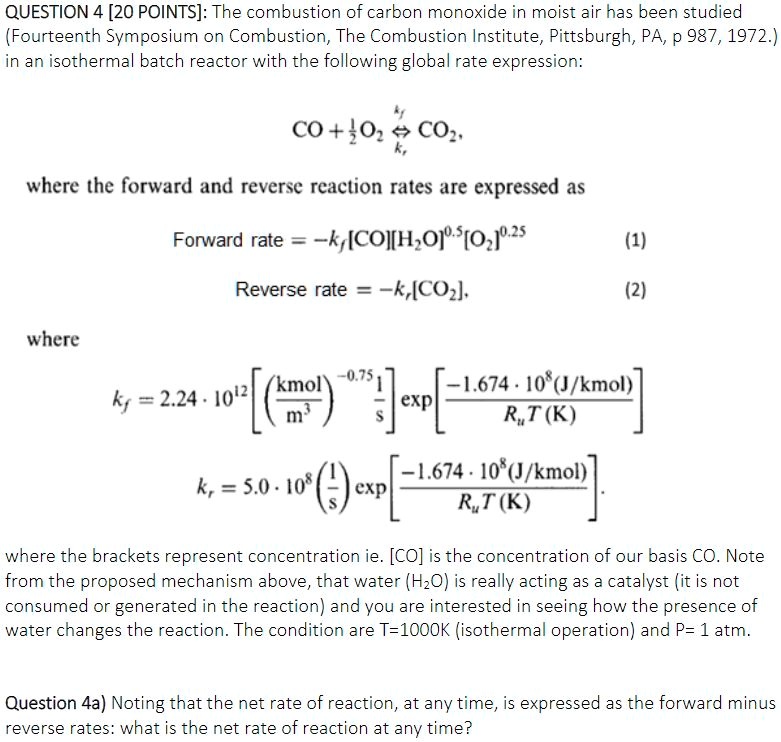
QUESTION 4 [20 POINTS]: The combustion of carbon monoxide in moist air has been studied (Fourteenth Symposium on Combustion, The Combustion Institute, Pittsburgh, PA, p 987, 1972.) in an isothermal batch reactor with the following global rate expression: CO + \frac{1}{2}O_2 \overset{k_f}{\underset{k_r}{\rightleftharpoons}} CO_2, where the forward and reverse reaction rates are expressed as Forward rate = $-k_f[CO][H_2O]^{0.5}[O_2]^{0.25}$ Reverse rate = $-k_r[CO_2]$, (1) (2) where $k_f = 2.24 \cdot 10^{12} \left(\frac{kmol}{m^3}\right)^{-0.75} \left(\frac{1}{s}\right) \exp\left[\frac{-1.674 \cdot 10^8 (J/kmol)}{R_uT(K)}\right]$ $k_r = 5.0 \cdot 10^8 \left(\frac{1}{s}\right) \exp\left[\frac{-1.674 \cdot 10^8 (J/kmol)}{R_uT(K)}\right]$. where the brackets represent concentration ie. [CO] is the concentration of our basis CO. Note from the proposed mechanism above, that water (H?O) is really acting as a catalyst (it is not consumed or generated in the reaction) and you are interested in seeing how the presence of water changes the reaction. The condition are T=1000K (isothermal operation) and P= 1 atm. Question 4a) Noting that the net rate of reaction, at any time, is expressed as the forward minus reverse rates: what is the net rate of reaction at any time?
View Answer
divider
BEST MATCH

For this problem, you'll be using some data on PTC tasting that has been collected over the past several semesters from biological anthropology lab classes. Like the MN blood group system, the ability to taste PTC can be modeled as a single-gene trait; unlike the MN blood group system, the two alleles at the PTC locus are not co-dominant. Instead, the allele for being able to taste PTC, which we'll call T, is dominant, while the non-taster allele, t, is recessive. Because one PTC allele is dominant over the other, we must approach the calculation of allele and genotype frequencies a little differently – we cannot obtain every individual's genotype from his or her phenotype like we could with the MN blood group data. Why not?

View Answer
divider