Ace - AI Tutor
Ask Our Educators
Textbooks
My Library
Flashcards
Scribe - AI Notes
Notes & Exams
Download App
brett cisneros

brett c.

Divider

Questions asked

BEST MATCH

Measurements show that the enthalpy of a mixture of gaseous reactants decreases by 223.kJ during a certain chemical reaction, which is carried out at a constant pressure. Furthermore, by carefully monitoring the volume change it is determined that 75.kJ of work is done on the mixture during the reaction. Calculate the change in energy of the gas mixture during the reaction. Round your answer to 3 significant digits. kJ Is the reaction exothermic or endothermic? exothermic endothermic

View Answer
divider
BEST MATCH

If we say that someone is attacking a problem with right-brain thinking, this refers to their ability to __________. Group of answer choices use focus and attention use insight and intuition use organization and detail use logical and analysis

View Answer
divider
BEST MATCH

The Federal Reserve System suddenly raises the federal discount rate, resulting in significantly higher interest rates for consumers and businesses that want to purchase property, vehicles, machinery, or other items on credit. Which factor in the firm's external environment does this BEST reflect? A. Competitive environment B. Economic environment C. Sociocultural environment D. Demographic environment E. Political-legal environment

View Answer
divider
BEST MATCH

0. Investment from abroad a. is a way for poor countries to learn the state-of-the-art technologies developed and used in richer countries. b. is viewed by economists as a way to increase growth.

View Answer
divider
BEST MATCH

Researchers noted those in favor of the war on Iraq used the language of ____ to generate support. A anger B racism C patriotism D hate

View Answer
divider
BEST MATCH

Which refers to a network of healthcare providers that practice value-based care and they agree to be paid based on results?

View Answer
divider
BEST MATCH

4. Given the conditions associated with each situation below, calculate the resulting gradient wind velocities. Drawing a diagram of the situation will help you resolve signs for R and for $\frac{\partial p}{\partial n}$. a. cyclonic flow around L pressure at 35°N $f = 8.37 \times 10^{-5} s^{-1}$; $R = 350$ km; $\rho = 1$ kg $m^{-3}$; $\frac{\partial p}{\partial n} = 300$ Pa/300 km b. anticyclonic flow around H pressure at 45°N (two solutions) $f = 1.03 \times 10^{-4} s^{-1}$; $R = 450$ km; $\rho = 1$ kg $m^{-3}$; $\frac{\partial p}{\partial n} = 100$ Pa/300 km

View Answer
divider
BEST MATCH

LOMA 281 Module 2 Exam English 15 of 20 Abby Miller purchased a typical five-year increasing term life insurance policy on the life of her husband, Sam. With regard to whether the benefit amount and premium amount for her policy will change during the policy's term, it is correct to say that the policy benefit will increase at stated intervals over the policy term, but the policy premium will remain the same over the policy term the policy benefit will decrease at stated intervals over the policy term, but the policy premium will remain the same over the policy term both the policy benefit and the policy premium will decrease at stated intervals over the policy term both the policy benefit and the policy premium will increase at stated intervals over the policy term

View Answer
divider
BEST MATCH

Suppose a teacher randomly chooses between freshmen, sophomores, juniors, and seniors to give a survey to. Once the teacher chooses the year of the student, the professor gives the survey to all students in that year. What sort of random sampling technique is this? A. Clustered sampling B. Stratified random sampling C. Census sampling D. Convenience sample

View Answer
divider
BEST MATCH

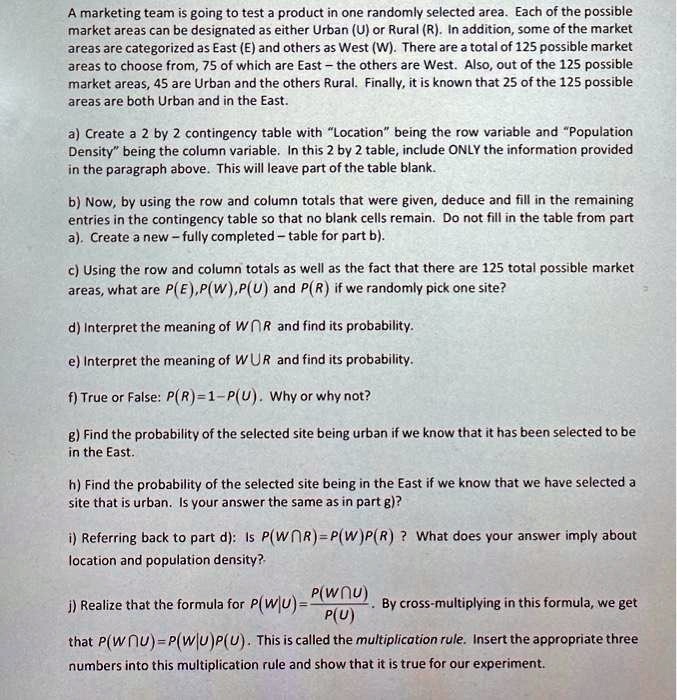
Texts: A marketing team is going to test a product in one randomly selected area. Each of the possible market areas can be designated as either Urban (U) or Rural (R). In addition, some of the market areas are categorized as East (E) and others as West (W). There are a total of 125 possible market areas to choose from, 75 of which are East - the others are West. Also, out of the 125 possible market areas, 45 are Urban and the others are Rural. Finally, it is known that 25 of the 125 possible areas are both Urban and in the East. a) Create a 2 by 2 contingency table with Location being the row variable and "Population Density" being the column variable. In this 2 by 2 table, include ONLY the information provided in the paragraph above. This will leave part of the table blank. | | Urban | Rural | |----------|-------|-------| | East | | | | West | | | b) Now, by using the row and column totals that were given, deduce and fill in the remaining entries in the contingency table so that no blank cells remain. Do not fill in the table from part a). Create a new fully completed table for part b). | | Urban | Rural | |----------|-------|-------| | East | 25 | 50 | | West | 20 | 30 | c) Using the row and column totals as well as the fact that there are 125 total possible market areas, what are P(E), P(W, U), and P(R) if we randomly pick one site? P(E) = 75/125 = 3/5 P(W, U) = 20/125 = 4/25 P(R) = 80/125 = 16/25 d) Interpret the meaning of P(W, R) and find its probability. P(W, R) represents the probability of selecting a market area that is both Rural and in the West. Its probability can be calculated as follows: P(W, R) = 1 - P(E, R) - P(W, U) = 1 - (50/125) - (4/25) = 1 - 2/5 - 4/25 = 1 - 10/25 - 4/25 = 1 - 14/25 = 11/25 e) Interpret the meaning of P(W, U, R) and find its probability. P(W, U, R) represents the probability of selecting a market area that is both Urban, Rural, and in the West. Since it is not possible for a market area to be both Urban and Rural at the same time, P(W, U, R) = 0. f) True or False: P(R) = 1 - P(U). Why or why not? False. P(R) does not equal 1 - P(U) because there is a possibility of market areas being both Urban and Rural. Therefore, P(R) = 80/125 ≠ 1 - P(U). g) Find the probability of the selected site being urban if we know that it has been selected to be in the East. P(U|E) = P(U, E) / P(E) = 25/125 / 75/125 = 25/75 = 1/3 h) Find the probability of the selected site being in the East if we know that we have selected a site that is urban. Is your answer the same as in part g)? P(E|U) = P(E, U) / P(U) = 25/125 / 45/125 = 25/45 ≠ 1/3. The answer is not the same as in part g. i) Referring back to part d, is P(W, R) = P(W) * P(R)? What does your answer imply about location and population density? No, P(W, R) ≠ P(W) * P(R). This implies that the events of being in the West and being Rural are not independent of each other. The probability of both events occurring together is not equal to the product of their individual probabilities. By cross-multiplying in this formula, we get that P(W, U) = P(W) * P(U). This is called the multiplication rule. Insert the appropriate three numbers into this multiplication rule and show that it is true for our experiment. P(W, U) = (20/125) = (20/125) * (45/125) = P(W) * P(U)
View Answer
divider