Fe³? (aq) + SCN? (aq) ? FeSCN²? (aq)
(yellow) (colorless) (red)
The color of the mixture should be red and is due to the iron(III) thiocyanate complex that
formed. If the reaction at equilibrium is disturbed, the color will change to reflect this. If the
equilibrium shifts towards the product, then the mixture will darken to indicate more complex being
formed. If the equilibrium shifts towards the reactant, then the mixture will lighten to indicate less
complex present.
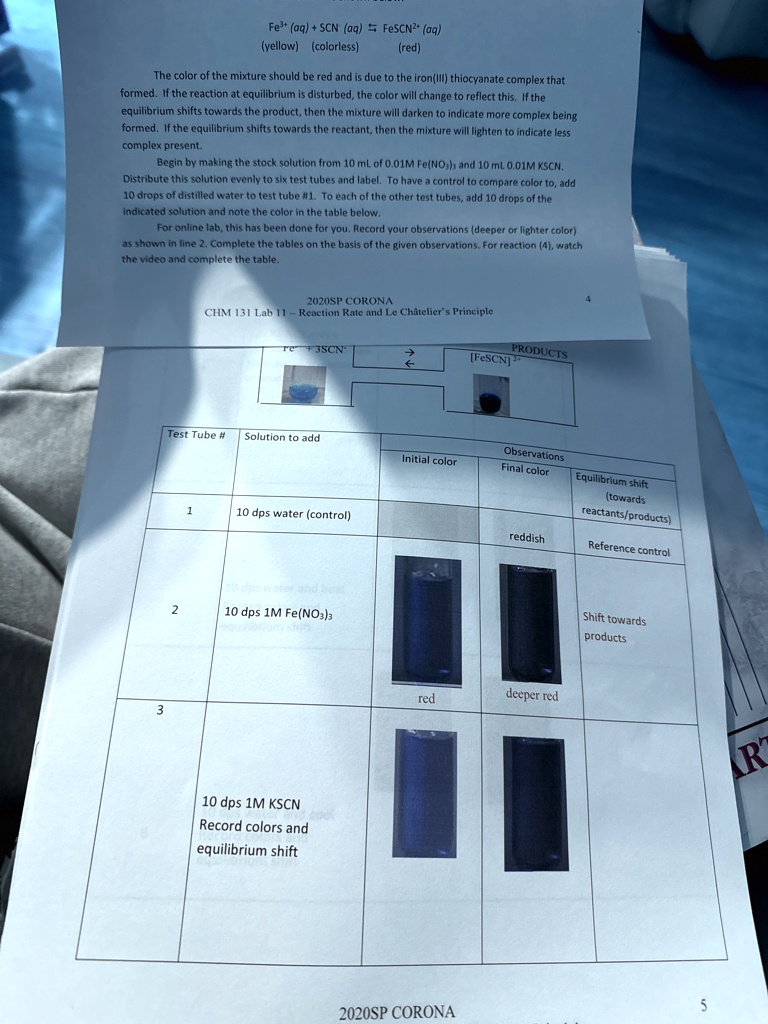
Begin by making the stock solution from 10 mL of 0.01M Fe(NO?)? and 10 mL 0.01M KSCN.
Distribute this solution evenly to six test tubes and label. To have a control to compare color to, add
10 drops of distilled water to test tube #1. To each of the other test tubes, add 10 drops of the
included solution and note the color in the table below.
For online lab, this has been done for you. Record your observations (deeper or lighter color)
as shown in line 2. Complete the tables on the basis of the given observations. For reaction (4), watch
the video and complete the table.
2020SP CORONA
CHM 131 Lab 11 - Reaction Rate and Le Châtelier's Principle
Fe³? + 3SCN? ? [FeSCN]²?
Test Tube #
Solution to add
Initial color
Observations
Final color
Equilibrium shift
(towards
reactants/products)
1
10 dps water (control)
reddish
Reference control
2
10 dps 1M Fe(NO?)?
red
deeper red
Shift towards
products
10 dps 1M KSCN
Record colors and
equilibrium shift
2020SP CORONA