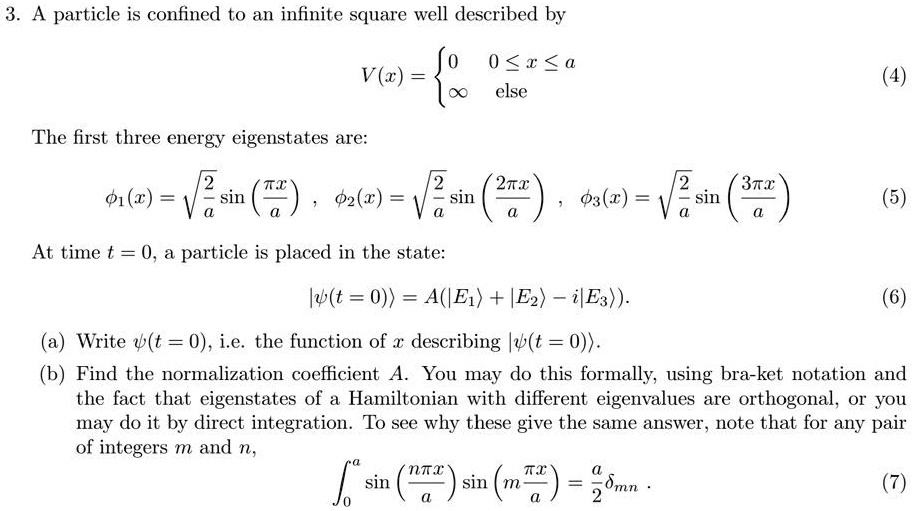
3. A particle is confined to an infinite square well described by
V(x) = \begin{cases} 0 & 0 \le x \le a \\ \infty & \text{else} \end{cases}
(4)
The first three energy eigenstates are:
$\phi_1(x) = \sqrt{\frac{2}{a}} \sin(\frac{\pi x}{a})$, $\phi_2(x) = \sqrt{\frac{2}{a}} \sin(\frac{2\pi x}{a})$, $\phi_3(x) = \sqrt{\frac{2}{a}} \sin(\frac{3\pi x}{a})$
(5)
At time $t = 0$, a particle is placed in the state:
$|\psi(t = 0)\rangle = A(|E_1\rangle + |E_2\rangle - i|E_3\rangle)$.
(6)
(a) Write $\psi(t = 0)$, i.e. the function of $x$ describing $|\psi(t = 0)\rangle$.
(b) Find the normalization coefficient A. You may do this formally, using bra-ket notation and
the fact that eigenstates of a Hamiltonian with different eigenvalues are orthogonal, or you
may do it by direct integration. To see why these give the same answer, note that for any pair
of integers m and n,
$\int_0^a \sin(\frac{n\pi x}{a}) \sin(\frac{m\pi x}{a}) dx = \frac{a}{2}\delta_{mn}$.
(7)