Ace - AI Tutor
Ask Our Educators
Textbooks
My Library
Flashcards
Scribe - AI Notes
Notes & Exams
Download App
brian diaz

brian d.

Divider

Questions asked

BEST MATCH

Select the proper order in performing Audit Data Analytics: Evaluate the results and conclude on whether the purpose and specific objectives of performing the ADA have been achieved Consider the relevance and reliability of the data used Plan the ADA Perform the ADA Access and prepare the data for purposes of the ADA Multiple Choice 5, 3, 2, 4, 1one 2, 3, 5, 4, 1one 2, 5, 3, 4, 1one 3, 5, 2, 4, 1

View Answer
divider
BEST MATCH

My Apps Dashboard | Indian five Content Bladboard https//irsc.blackboard.com/ultra/courses/_129303_1/d/outline ection 2.4b - Completing the Square core: 13/14 Answered: 14/14 Question 1 Score on last try: 0.5 of 1 pts. See Details for more. Next question Get a similar question You can retry this question below Determine the constant that should be added to the following binomial so that it becomes a perfect square trinomial. \[ x^{2}+24 x+144 \quad \sigma^{\circ} \] Write the perfect square trinomial in factored form: \begin{tabular}{|c|c|c|c|c|c|c|c|} \hline Basic & Funcs & \multicolumn{4}{|l|}{Trig} & & x \\ \hline \( x \) & - & x & \( x \) & \( \sqrt{ } \) & \( \sqrt[n]{ } \) & \( \uparrow \) & \( \downarrow \) \\ \hline & ( ) & 11 & \( \pi \) & ( & DNE & \( \leftarrow \) & \( \rightarrow \) \\ \hline \end{tabular} Enter an algebraic expression [more.] Search

View Answer
divider
BEST MATCH

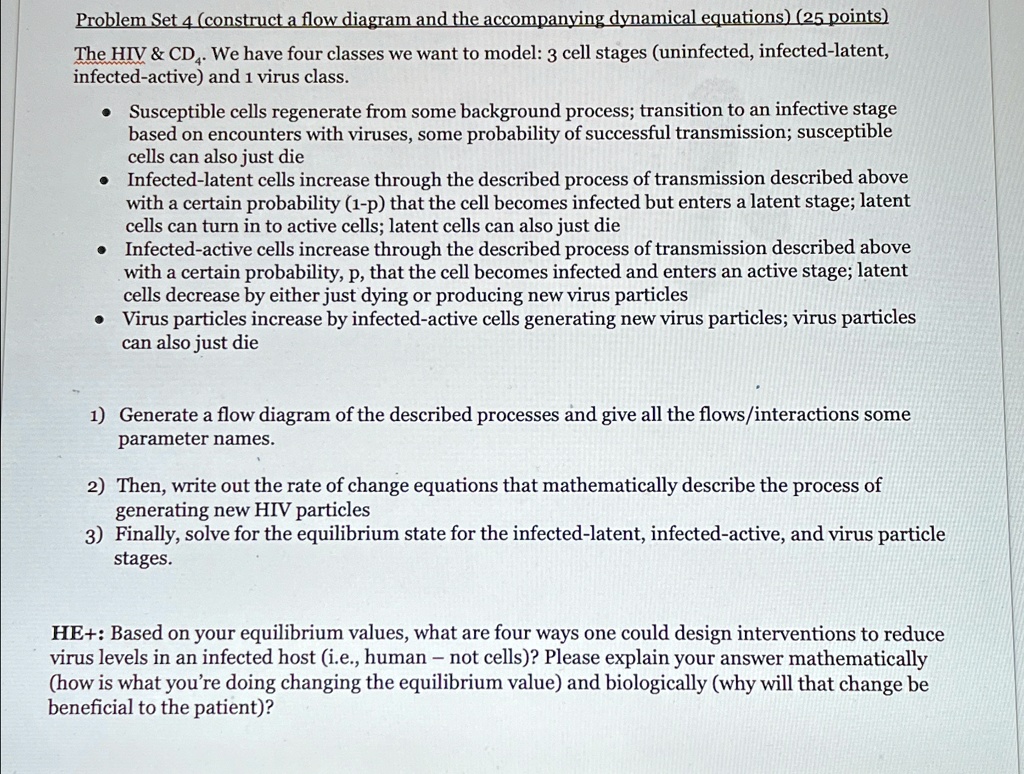
Problem Set 4 (construct a flow diagram and the accompanying dynamical equations) (25 points) The HIV & CD_(4). We have four classes we want to model: 3 cell stages (uninfected, infected-latent, infected-active) and 1 virus class. Susceptible cells regenerate from some background process; transition to an infective stage based on encounters with viruses, some probability of successful transmission; susceptible cells can also just die Infected-latent cells increase through the described process of transmission described above with a certain probability ( 1-p that the cell becomes infected but enters a latent stage; latent cells can turn in to active cells; latent cells can also just die Infected-active cells increase through the described process of transmission described above with a certain probability, p, that the cell becomes infected and enters an active stage; latent cells decrease by either just dying or producing new virus particles Virus particles increase by infected-active cells generating new virus particles; virus particles can also just die Generate a flow diagram of the described processes and give all the flows/interactions some parameter names. Then, write out the rate of change equations that mathematically describe the process of generating new HIV particles Finally, solve for the equilibrium state for the infected-latent, infected-active, and virus particle stages. HE+: Based on your equilibrium values, what are four ways one could design interventions to reduce virus levels in an infected host (i.e., human - not cells)? Please explain your answer mathematically (how is what you're doing changing the equilibrium value) and biologically (why will that change be beneficial to the patient)? Problem Set 4 (construct a flow diagram and the accompanving dynamical equations) (25 points) The HIV & CD.. We have four classes we want to model: 3 cell stages (uninfected, infected-latent, infected-activeand1 virus class Susceptible cells regenerate from some background process; transition to an infective stage based on encounters with viruses, some probability of successful transmission; susceptible cells can also just die Infected-latent cells increase through the described process of transmission described above with a certain probability (1-p) that the cell becomes infected but enters a latent stage; latent cells can turn in to active cells;latent cells can also just die Infected-active cells increase through the described process of transmission described above with a certain probability, p, that the cell becomes infected and enters an active stage; latent cells decrease by either just dying or producing new virus particles Virus particles increase by infected-active cells generating new virus particles; virus particles can also just die 1 Generate a flow diagram of the described processes and give all the flows/interactions some parameter names. 2 Then,write out the rate of change equations that mathematically describe the process of generating new HIV particles 3) Finally, solve for the equilibrium state for the infected-latent, infected-active, and virus particle stages. HE+: Based on your equilibrium values,what are four ways one could design interventions to reduce virus levels in an infected host (i.e., human -- not cells)? Please explain your answer mathematically (how is what you're doing changing the equilibrium value) and biologically (why will that change be beneficial to the patient)?
View Answer
divider
BEST MATCH

Sort the information below into the correct category. Glycolysis Krebs cycle No Answers Chosen Electron Transport Chain No Answers Chosen No Answers Chosen Possible answers Occurs at the plasma membrane in prokaryotic cells Occurs in the cytoplasm in prokaryotic cells only Occurs at the inner mitochondrial membrane Oxidative phosphorylation occurs here First step in cellular respiration Produces CO2 Occurs in the cytoplasm of both prokaryotic and eukaryotic cells Begins with glucose Generates pyruvate

View Answer
divider
BEST MATCH

What is the total change in energy (ΔE), in kJ, for a system where 213 kJ of work was done by the system and the system lost 79 kJ of heat? Question 3 Select one: a. +292 b. -292 c. +134 d. -134 e. -213

View Answer
divider
BEST MATCH

A hypothesis test is conducted at the a = 0.01 significance level to determine whether the mean weight of all MushiMint candies is less than 22 grams. In a sample of 66 MushiMint candies, the mean weight was 20.5 grams with a sample standard deviation of 0.25 grams. What is the critical region for this hypothesis test? all values of $t$ less than $-2.66$ all values of $t$ less than $-0.25$ all values of $t$ less than $-2.39$ all values of $t$ less than $-0.03

View Answer
divider
BEST MATCH

4) For figure 4 find... a) R<sub>T</sub> b) V<sub>A</sub> c) V<sub>BD</sub> d) V<sub>C</sub> e) V<sub>ED</sub> f) V<sub>O</sub>

View Answer
divider
BEST MATCH

(CHAPTER 8) Last year, you bought a share of stock for $55. Today, you decided to sell it, since it went in price to $62 a share. Also, over the year, the company paid you a $4 dividend. What was your total percentage return over the year? Let's break the solution to this problem into pieces: There are two components of total percentage return when you buy stock shares: the first one is related to the received dividend and it is called The second component is called (Do NOT use "%" in your answer. Round your answer to TWO decimal places, for example, 10.23) Calculating each of these two components gives ...and %, respectively. Therefore, your total percentage return over the year was %

View Answer
divider
BEST MATCH

1. Consider a coupon bond that has a $1,000 par value and a coupon rate of 9%. The bond is currently selling for $1,150 and has 9 years to maturity. What is the bond's yield to maturity? 2. You are willing to pay $15,625 now to purchase a perpetuity which will pay you and your heirs $1,350 each year, forever, starting at the end of this year. If your required rate of return does not change, how much would you be willing to pay if this were a 20-year, annual payment, ordinary annuity instead of a perpetuity? 3. Assume you just deposited $1,000 into a bank account. The current real interest rate is 3% and inflation is expected to be 6% over the next year. What nominal interest rate would you require from the bank over the next year? How much money will you have at the end of one year? If you are saving to buy a stereo that currently sells for $1,125, will you have enough to buy it?

View Answer
divider
BEST MATCH

You will write a program that will allow a user to make a (single) selection from a list of options. This is very common when writing programs and we will use it frequently throughout this class. Display the menu of choices to your user so that it looks like this: Items available for purchase: 1. Chicken Wrap $4.50 2. Wings (10) $16.99 3. Fries $4.59 4. Meatball Sub $8.39 5. Soup $2.95 Enter the number corresponding to the item that you would like to purchase: If the user enters a value outside of the range of values for your menu (that is, less than 1 or greater than 5), let them know that they have made an invalid choice and stop (use the if/elif/else statement logic to stop the program). If the user enters a valid number, ask them if they would like to add a tip. If yes, ask if they want to enter a percentage to indicate the tip amount or if they would like to add a set amount for the tip. (For instance, 18% tip (you may assume an integer if you wish) or a $2.00 tip). (The user should just enter numbers, not "%" or "$" signs -- you can assume that they do!). Tax on all items is 5% (and is calculated before the tip is added). Calculate the total amount of the item purchased, the tax and the tip and print it for the user to see. So, for instance if the user chooses 3 (Fries) and wants to leave a $2.00 tip, the total will be $6.82 (4.59 * 1.05 + 2.00). (Question from student: Should the tip be calculated before or after tax? Answer: I will accept either implementation). You may print just the total or a break down of the amount, tax and tip and total. Your choice.

View Answer
divider