Reset Help
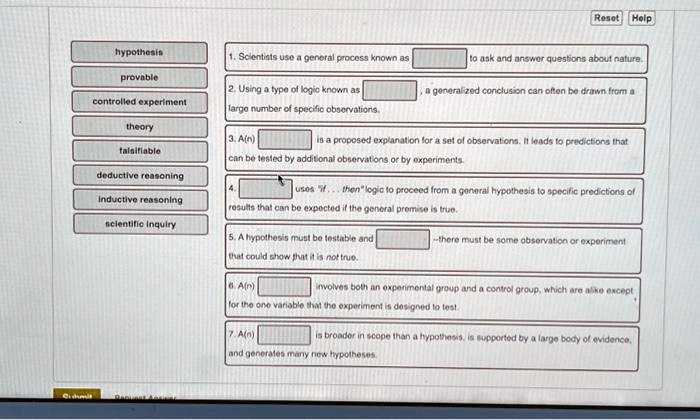
1. Scientists use a general process known as
to ask and answer questions about nature.
2. Using a type of logic known as
, a generalized conclusion can often be drawn from a
large number of specific observations.
3. A(n)
is a proposed explanation for a set of observations. It leads to predictions that
can be tested by additional observations or by experiments.
4.
uses "if...then" logic to proceed from a general hypothesis to specific predictions of
results that can be expected if the general premise is true.
5. A hypothesis must be testable and
---there must be some observation or experiment
that could show that it is not true.
6. A(n)
involves both an experimental group and a control group, which are alike except
for the one variable that the experiment is designed to test.
7. A(n)
is broader in scope than a hypothesis, is supported by a large body of evidence,
and generates many new hypotheses.