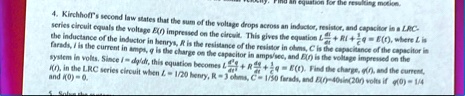
Kirchhoff's second law states that the sum of the voltage drops across an inductor, resistor, and capacitor in a LRC-series circuit equals the voltage $E(t)$ impressed on the circuit. This gives the equation $L\frac{di}{dt} + Ri + \frac{1}{C}q = E(t)$, where $L$ is the inductance of the inductor in henrys, $R$ is the resistance of the resistor in ohms, $C$ is the capacitance of the capacitor in farads, $i$ is the current in amps, $q$ is the charge on the capacitor in amps/sec, and $E(t)$ is the voltage impressed on the system in volts. Since $i = dq/dt$, this equation becomes $L\frac{d^2q}{dt^2} + R\frac{dq}{dt} + \frac{1}{C}q = E(t)$. Find the charge, $q(t)$, and the current, $i(t)$, in the LRC series circuit when $L = 1/20$ henry, $R = 3$ ohms, $C = 1/50$ farads, and $E(t) = 40\sin(20t)$ volts if $q(0) = 1/4$ and $i(0) = 0$.