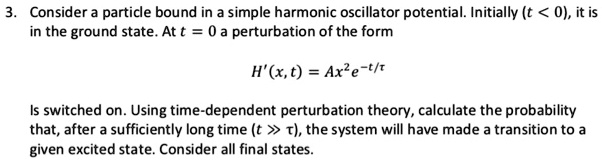
3. Consider a particle bound in a simple harmonic oscillator potential. Initially ($t < 0$), it is
in the ground state. At $t = 0$ a perturbation of the form
$H'(x,t) = Ax^2e^{-t/\tau}$
is switched on. Using time-dependent perturbation theory, calculate the probability
that, after a sufficiently long time ($t >> \tau$), the system will have made a transition to a
given excited state. Consider all final states.