Please help me answers questions 1 and 2 for my Thermal Analysis course, thank you in advance.
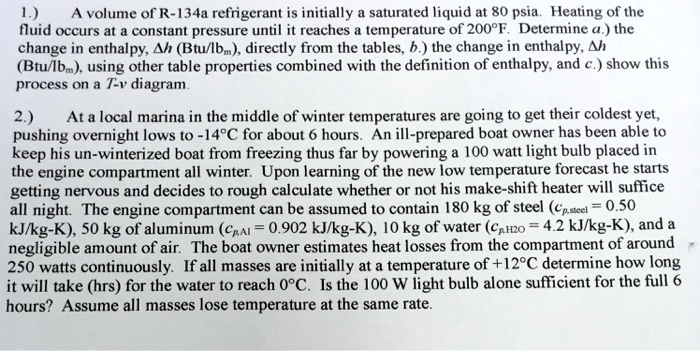
1.) A volume of R-l34a refrigerant is initially a saturated liquid at 80 psia. Heating of the fluid occurs at a constant pressure until it reaches a temperature of 200F.Determine a.) the change in enthalpy,h Btu/lbm,directly from the tables, b. the change in enthalpyh Btu/lbm),using other table properties combined with the definition of enthalpy,and c. show this process on a T-v diagram
2.) At a local marina in the middle of winter temperatures are going to get their coldest yet, pushing overnight lows to-14C for about 6 hours. An ill-prepared boat owner has been able to keep his un-winterized boat from freezing thus far by powering a 100 watt light bulb placed in the engine compartment all winter. Upon learning of the new low temperature forecast he starts getting nervous and decides to rough calculate whether or not his make-shift heater will suffice all night. The engine compartment can be assumed to contain 180 kg of steel (cp.stcel =0.50 kJ/kg-K,50 kg of aluminum cp.A=0.902 kJ/kg-K,10 kg of watercH2o=4.2 kJ/kg-K,and a negligible amount of air. The boat owner estimates heat losses from the compartment of around 250 watts continuously. If all masses are initially at a temperature of +12C determine how long it will take (hrsfor the water to reach 0C. Is the 100 W light bulb alone sufficient for the full 6 hours? Assume all masses lose temperature at the same rate.