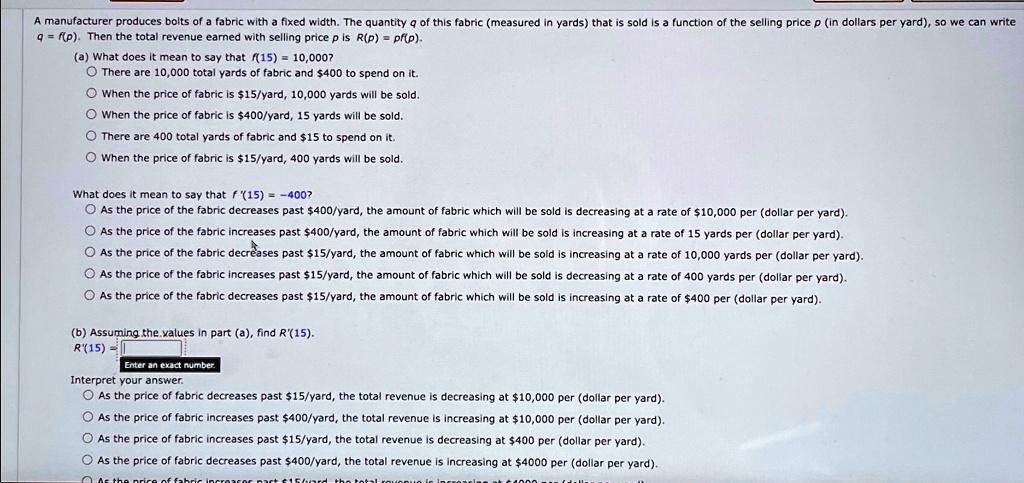
q = f(p). Then the total revenue earned with selling price p is R(p) = pf(p).
(a) What does it mean to say that f(15) = 10,000?
There are 10,000 total yards of fabric and $400 to spend on it.
When the price of fabric is $15/yard, 10,000 yards will be sold.
When the price of fabric is $400/yard, 15 yards will be sold.
There are 400 total yards of fabric and $15 to spend on it.
When the price of fabric is $15/yard, 400 yards will be sold.
What does it mean to say that f'(15) = -400?
As the price of the fabric decreases past $400/yard, the amount of fabric which will be sold is decreasing at a rate of $10,000 per (dollar per yard).
As the price of the fabric increases past $400/yard, the amount of fabric which will be sold is increasing at a rate of 15 yards per (dollar per yard).
As the price of the fabric decreases past $15/yard, the amount of fabric which will be sold is increasing at a rate of 10,000 yards per (dollar per yard).
As the price of the fabric increases past $15/yard, the amount of fabric which will be sold is decreasing at a rate of 400 yards per (dollar per yard).
As the price of the fabric decreases past $15/yard, the amount of fabric which will be sold is increasing at a rate of $400 per (dollar per yard).
(b) Assuming the values in part (a), find R'(15).
R'(15) =
Enter an exact number.
Interpret your answer.
As the price of fabric decreases past $15/yard, the total revenue is decreasing at $10,000 per (dollar per yard).
As the price of fabric increases past $400/yard, the total revenue is increasing at $10,000 per (dollar per yard).
As the price of fabric increases past $15/yard, the total revenue is decreasing at $400 per (dollar per yard).
As the price of fabric decreases past $400/yard, the total revenue is increasing at $4000 per (dollar per yard).
A manufacturer produces bolts of a fabric with a fixed width. The quantity q of this fabric (measured in yards that is sold is a function of the selling price p in dollars per yard), so we can write q = f(p). Then the total revenue earned with selling price p is R(p) = pf(p).
What does it mean to say that f(15) = 10,000?
There are 10,000 total yards of fabric and $400 to spend on it.
When the price of fabric is $15/yard, 10,000 yards will be sold.
When the price of fabric is $400/yard, 15 yards will be sold.
There are 400 total yards of fabric and $15 to spend on it.
When the price of fabric is $15/yard, 400 yards will be sold.
What does it mean to say that f(15) = -400?
As the price of the fabric decreases past $400/yard, the amount of fabric which will be sold is decreasing at a rate of $10,000 per (dollar per yard).
As the price of the fabric increases past $400/yard, the amount of fabric which will be sold is increasing at a rate of 15 yards per dollar per yard.
As the price of the fabric decreases past $15/yard, the amount of fabric which will be sold is increasing at a rate of 10,000 yards per (dollar per yard).
As the price of the fabric increases past $15/yard, the amount of fabric which will be sold is decreasing at a rate of 400 yards per (dollar per yard).
As the price of the fabric decreases past $15/yard, the amount of fabric which will be sold is increasing at a rate of $400 per dollar per yard.
Assuming the values in part a, find R(15).
R(15) = Enter an exact number.
Interpret your answer.
As the price of fabric decreases past $15/yard, the total revenue is decreasing at $10,000 per (dollar per yard).
As the price of fabric increases past $400/yard, the total revenue is increasing at $10,000 per (dollar per yard).
As the price of fabric increases past $15/yard, the total revenue is decreasing at $400 per (dollar per yard).
As the price of fabric decreases past $400/yard, the total revenue is increasing at $4000 per (dollar per yard).