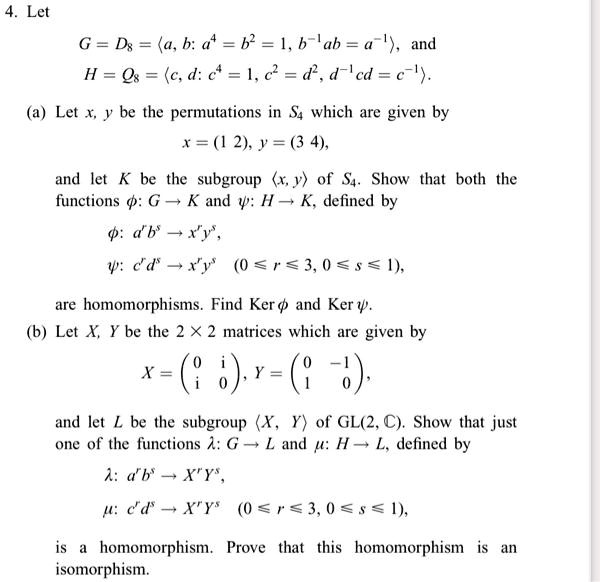
4. Let
G = D? = \(a, b: a? = b² = 1, b?¹ab = a?¹\), and
H = Q? = \(c, d: c? = 1, c² = d², d?¹cd = c?¹\).
(a) Let x, y be the permutations in S? which are given by
x = (1 2), y = (3 4),
and let K be the subgroup \(x, y\) of S?. Show that both the
functions ?: G ? K and ?: H ? K, defined by
?: a?b? ? x?y?,
?: c?d? ? x?y? (0 ? r ? 3, 0 ? s ? 1),
are homomorphisms. Find Ker ? and Ker ?.
(b) Let X, Y be the 2 × 2 matrices which are given by
X = \begin{pmatrix} 0 & i \ i & 0 \end{pmatrix}, Y = \begin{pmatrix} 0 & -1 \ 1 & 0 \end{pmatrix},
and let L be the subgroup \(X, Y\) of GL(2, C). Show that just
one of the functions ?: G ? L and ?: H ? L, defined by
?: a?b? ? X?Y?,
?: c?d? ? X?Y? (0 ? r ? 3, 0 ? s ? 1),
is a homomorphism. Prove that this homomorphism is an
isomorphism.