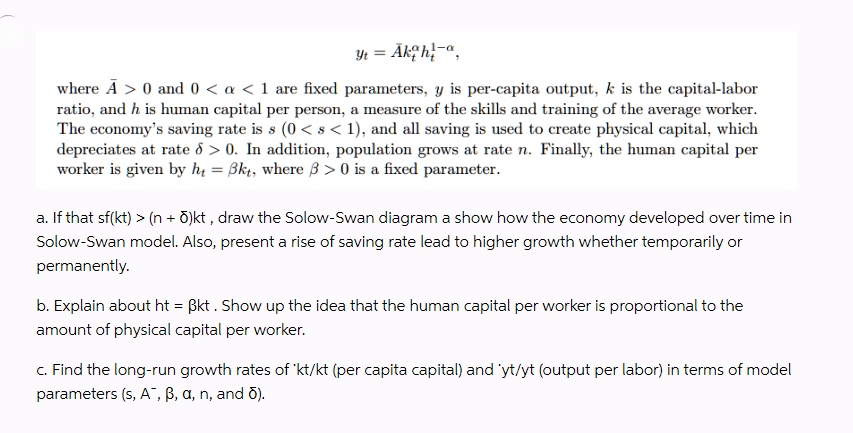
Yt = \tilde{A}k_t^\alpha h_t^{1-\alpha},
where \tilde{A} > 0 and 0 < \alpha < 1 are fixed parameters, y is per-capita output, k is the capital-labor
ratio, and h is human capital per person, a measure of the skills and training of the average worker.
The economy's saving rate is s (0 < s < 1), and all saving is used to create physical capital, which
depreciates at rate \delta > 0. In addition, population grows at rate n. Finally, the human capital per
worker is given by $h_t = \beta k_t$, where \beta > 0 is a fixed parameter.
a. If that sf(kt) > (n + \delta)kt, draw the Solow-Swan diagram a show how the economy developed over time in
Solow-Swan model. Also, present a rise of saving rate lead to higher growth whether temporarily or
permanently.
b. Explain about $h_t = \beta k_t$. Show up the idea that the human capital per worker is proportional to the
amount of physical capital per worker.
c. Find the long-run growth rates of $k_t/k_t$ (per capita capital) and $y_t/y_t$ (output per labor) in terms of model
parameters (s, \tilde{A}, \beta, \alpha, n, and \delta).