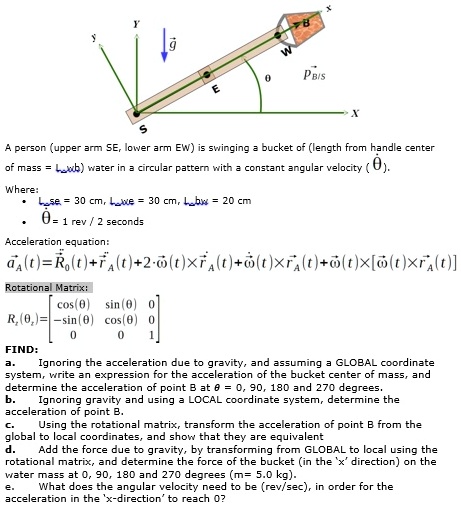
A person (upper arm SE, lower arm EW) is swinging a bucket of (length from handle center of mass = $l_{bw}$) water in a circular pattern with a constant angular velocity ($\dot{\theta}$).
Where:
$\bullet$ $l_{se}$ = 30 cm, $l_{we}$ = 30 cm, $l_{bw}$ = 20 cm
$\bullet$ $\dot{\theta}$ = 1 rev / 2 seconds
Acceleration equation:
$\vec{a}_A(t) = \dot{R}_0(t) + \vec{a}_A(t) + 2\vec{\omega}(t) \times \vec{r}_A(t) + \vec{\omega}(t) \times [\vec{\omega}(t) \times \vec{r}_A(t)]$
Rotational Matrix:
$R_0(\theta) = \begin{bmatrix} cos(\theta) & sin(\theta) & 0\\ -sin(\theta) & cos(\theta) & 0\\ 0 & 0 & 1 \end{bmatrix}$
FIND:
a. Ignoring the acceleration due to gravity, and assuming a GLOBAL coordinate system, write an expression for the acceleration of the bucket center of mass, and determine the acceleration of point B at $\theta$ = 0, 90, 180 and 270 degrees.
b. Ignoring gravity and using a LOCAL coordinate system, determine the acceleration of point B.
c. Using the rotational matrix, transform the acceleration of point B from the global to local coordinates, and show that they are equivalent
d. Add the force due to gravity, by transforming from GLOBAL to local using the rotational matrix, and determine the force of the bucket (in the 'x' direction) on the water mass at 0, 90, 180 and 270 degrees (m = 5.0 kg).
e. What does the angular velocity need to be (rev/sec), in order for the acceleration in the 'x-direction' to reach 0?