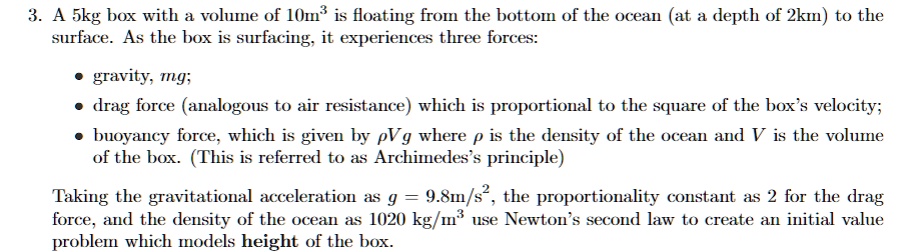
3. A 5kg box with a volume of 10m³ is floating from the bottom of the ocean (at a depth of 2km) to the
surface. As the box is surfacing, it experiences three forces:
• gravity, mg;
• drag force (analogous to air resistance) which is proportional to the square of the box's velocity;
• buoyancy force, which is given by $\rho Vg$ where $\rho$ is the density of the ocean and V is the volume
of the box. (This is referred to as Archimedes's principle)
Taking the gravitational acceleration as g = 9.8m/s², the proportionality constant as 2 for the drag
force, and the density of the ocean as 1020 kg/m³ use Newton's second law to create an initial value
problem which models height of the box.