PROBLEM 3
I. Suppose that X and Y are independent exponential random variables, with \(\lambda_x = 2\) and \(\lambda_y = 2\). Find the proba-
bility density function of Z = X + Y.
II. Suppose that X and Y have the following joint probability distribution given by
\(f_{XY}(x, y) = \begin{cases} 2 & \text{for } 0 \le x \le 1, 0 \le y \le 1, 0 \le x + y \le 1\\ 0 & \text{otherwise.} \end{cases}\)
Find E(X + Y) and Var(X + Y).
PROBLEM 4
Suppose X and Y are independent random variables and each is equally likely to take the values 2 and 0. Calculate
the correlation between the random variables W := X + Y and Z := X - Y.
PROBLEM 5
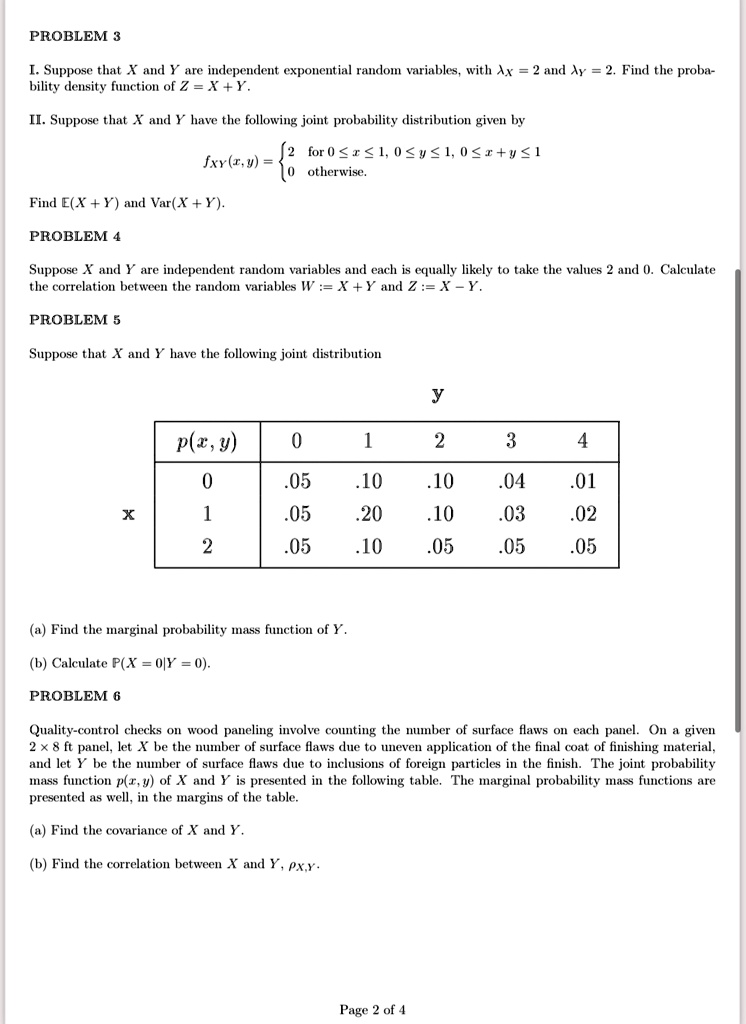
Suppose that X and Y have the following joint distribution
y
p(x, y)
0
1
2
3
4
0
.05
.10
.10
.04
.01
X
1
.05
.20
.10
.03
.02
2
.05
.10
.05
.05
.05
(a) Find the marginal probability mass function of Y.
(b) Calculate P(X = 0|Y = 0).
PROBLEM 6
Quality-control checks on wood paneling involve counting the number of surface flaws on each panel. On a given
2 \times 8 ft panel, let X be the number of surface flaws due to uneven application of the final coat of finishing material,
and let Y be the number of surface flaws due to inclusions of foreign particles in the finish. The joint probability
mass function p(x, y) of X and Y is presented in the following table. The marginal probability mass functions are
presented as well, in the margins of the table.
(a) Find the covariance of X and Y.
(b) Find the correlation between X and Y, \(\rho_{X,Y}\).