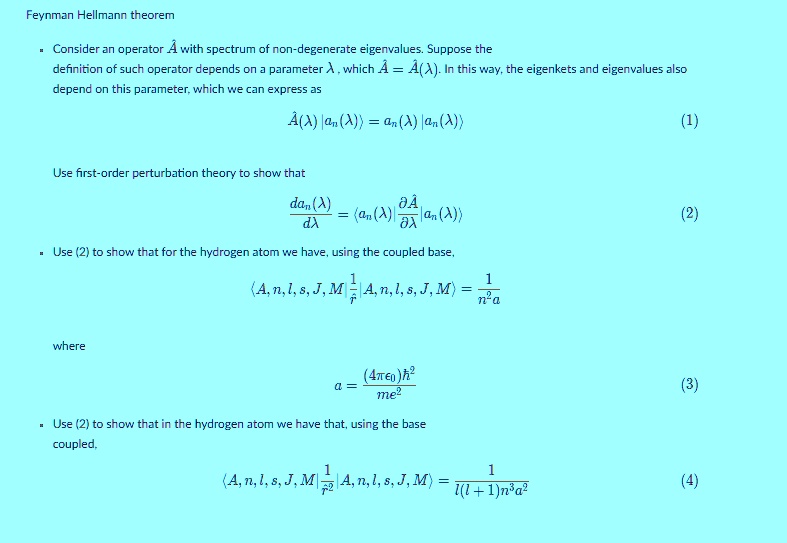
Feynman Hellmann theorem
Consider an operator $\hat{A}$ with spectrum of non-degenerate eigenvalues. Suppose the
definition of such operator depends on a parameter $\lambda$, which $\hat{A} = \hat{A}(\lambda)$. In this way, the eigenkets and eigenvalues also
depend on this parameter, which we can express as
$\hat{A}(\lambda)|a_n(\lambda)\rangle = a_n(\lambda)|a_n(\lambda)\rangle$
Use first-order perturbation theory to show that
$\frac{da_n(\lambda)}{d\lambda} = \langle a_n(\lambda)|\frac{\partial \hat{A}}{\partial \lambda}|a_n(\lambda)\rangle$
Use (2) to show that for the hydrogen atom we have, using the coupled base,
$\langle A, n, l, s, J, M|\frac{1}{r}|A, n, l, s, J, M\rangle = \frac{1}{n^2a}$
where
$a = \frac{(4\pi\epsilon_0)^2\hbar^2}{me^2}$
Use (2) to show that in the hydrogen atom we have that, using the base
coupled,
$\langle A, n, l, s, J, M|\frac{1}{r^2}|A, n, l, s, J, M\rangle = \frac{1}{l(l+1)n^3a^2}$