(1)
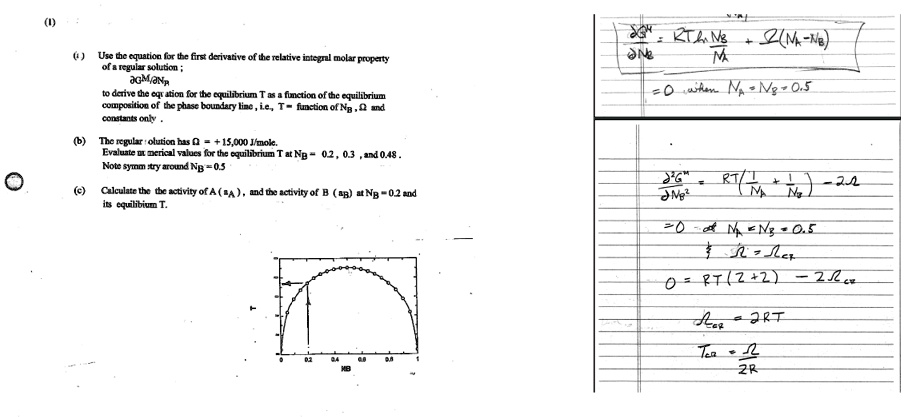
(a) Use the equation for the first derivative of the relative integral molar property
of a regular solution;
$\frac{\partial G^M}{\partial N_B}$;
to derive the equation for the equilibrium T as a function of the equilibrium
composition of the phase boundary line, i.e., T = function of $N_B$, $\Omega$ and
constants only.
(b) The regular solution has $\Omega = +15,000$ J/mole.
Evaluate numerical values for the equilibrium T at $N_B = 0.2$, $0.3$, and $0.48$.
Note symmetry around $N_B = 0.5$
(c) Calculate the activity of A ($a_A$), and the activity of B ($a_B$) at $N_B = 0.2$ and
its equilibrium T.