Questions asked
HClO4(aq) + H2O(l) → ClO4-(aq) + H3O+(aq) Acid Choose one: O HClO4 O H2O O ClO4- O H3O+ Base Choose one: O HClO4 O H2O
Given the following equilibrium reaction: NH4Cl(s) ⇌NH4(aq) + Cl- ; ∆Hrxn > 0 Which direction would the equilibrium shift given the following changes/disruptions to the reaction? Question 2 options: 123 Addition of solid NH4Cl 123 Addition of NaOH 123 Increasing the temperature 123 Addition of HCl 123 Addition of water (H2O) 1. Shift Left (toward reactants) 2. Shift Right (toward products) 3. No shift will occur
You need 1(1)/(4) cups of sugar to make 20 cookies To make 14 cookies, you will need exactly how many cups of sugar?
_____________________________________ are the fast-adapting type of sensory receptors. They sense a stimulus and then shut down very quickly. Tonic receptors, exteroceptors, interoceptors, phasic receptors
What value of Fmax gives an impulse of 8.4 Ns ?
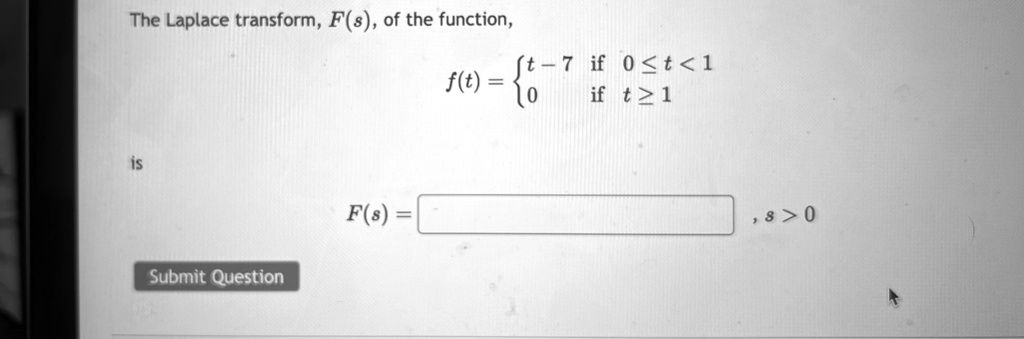
The Laplace transform, $F(s)$, of the function, $f(t) = \begin{cases} t - 7 & \text{if } 0 \le t < 1 \\ 0 & \text{if } t \ge 1 \end{cases}$ is $F(s) = \underline{\qquad\qquad\qquad}, s > 0$
I want to know what the average variable cost looks like in a natural monopoly
A monopolist faces two types of customers but cannot identify the type. Demand of Type A customers is given by QA = 50-PA and demand of Type B customers by QB=80-PB. There are equally many of each type of consumer. Assume the monopolist’s cost function is given by C(Q) = 100Q. Find the two-part tariff T(Q) =F + vQ that this monopolist could charge for its products if the goal of the monopolist is to get both types of consumers in the park. Group of answer choices V*=$100 and F=$800 V*=$10 and F=$1400 V*=$100 and F=$2450 V*=$10 and F=$3200
Predict the major product of the reaction. H?O, heat SH Select Draw Templates More / C H O S
Complete the following reactions and draw the transition state or intermediate: HBr dark 1. BH$_3$ THF 2. H$_2$O$_2$ HO 1. Hg(ACO)$_2$, H$_2$O 2. NaBH$_4$ HO Br$_2$ dark Chapter 9 Predict the $^1$H and $^{13}$C spectra for the following two compounds include integration relative shift and splitting 10 200 0 0 10 0 200 0