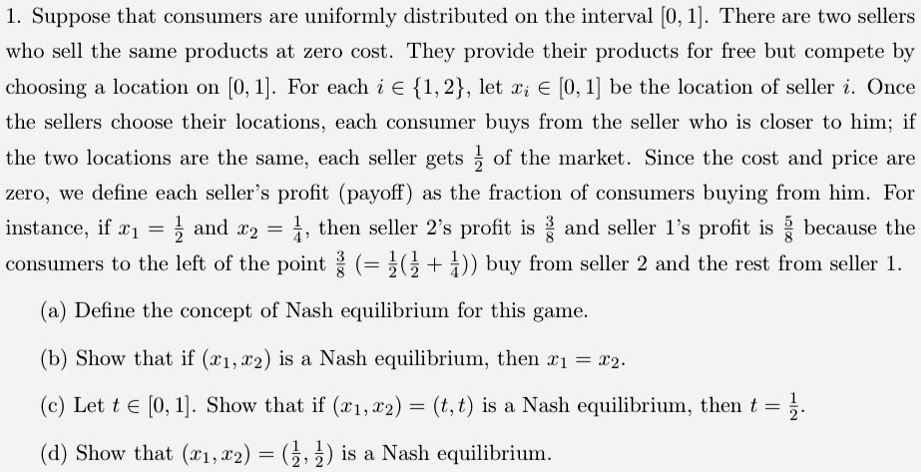
1. Suppose that consumers are uniformly distributed on the interval [0, 1]. There are two sellers
who sell the same products at zero cost. They provide their products for free but compete by
choosing a location on [0, 1]. For each i ∈ {1,2}, let xi ∈ [0, 1] be the location of seller i. Once
the sellers choose their locations, each consumer buys from the seller who is closer to him; if
the two locations are the same, each seller gets of the market. Since the cost and price are
zero, we define each seller's profit (payoff) as the fraction of consumers buying from him. For
instance, if x1 = ½ and x2 = 1, then seller 2's profit is and seller 1's profit is because the
consumers to the left of the point (=(+)) buy from seller 2 and the rest from seller 1.
(a) Define the concept of Nash equilibrium for this game.
(b) Show that if (x1,x2) is a Nash equilibrium, then x1 = x2.
(c) Let t ∈ [0, 1]. Show that if (x1,x2) = (t, t) is a Nash equilibrium, then t =
(d) Show that (x1,x2) = (,) is a Nash equilibrium.
1
2
3
8
5
8
1
2
1
2
1
2