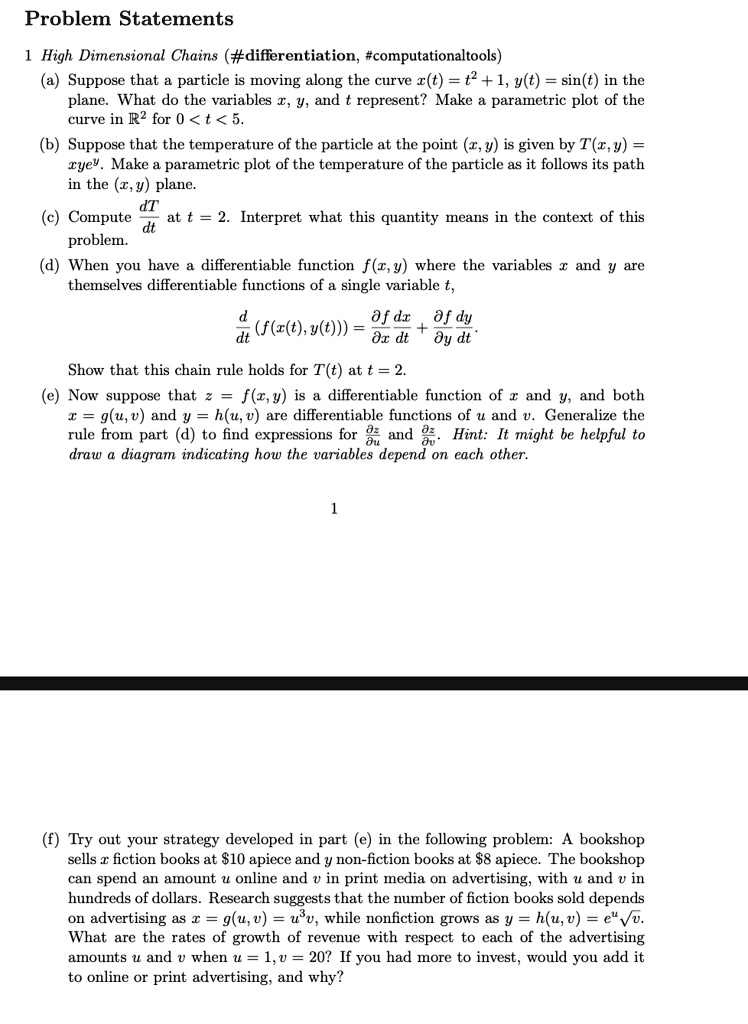
1 High Dimensional Chains (#differentiation, #computationaltools)
(a) Suppose that a particle is moving along the curve $x(t) = t^2 + 1$, $y(t) = \sin(t)$ in the
plane. What do the variables x, y, and t represent? Make a parametric plot of the
curve in $\mathbb{R}^2$ for $0 < t < 5$.
(b) Suppose that the temperature of the particle at the point $(x, y)$ is given by $T(x, y) = xye^x$. Make a parametric plot of the temperature of the particle as it follows its path
in the $(x, y)$ plane.
(c) Compute $\frac{dT}{dt}$ at $t = 2$. Interpret what this quantity means in the context of this
problem.
(d) When you have a differentiable function $f(x, y)$ where the variables x and y are
themselves differentiable functions of a single variable t,
$\frac{d}{dt}(f(x(t), y(t))) = \frac{\partial f}{\partial x}\frac{dx}{dt} + \frac{\partial f}{\partial y}\frac{dy}{dt}$
Show that this chain rule holds for $T(t)$ at $t = 2$.
(e) Now suppose that $z = f(x, y)$ is a differentiable function of x and y, and both
$x = g(u, v)$ and $y = h(u, v)$ are differentiable functions of u and v. Generalize the
rule from part (d) to find expressions for $\frac{\partial z}{\partial u}$ and $\frac{\partial z}{\partial v}$. Hint: It might be helpful to
draw a diagram indicating how the variables depend on each other.
(f) Try out your strategy developed in part (e) in the following problem: A bookshop
sells x fiction books at $10 apiece and y non-fiction books at $8 apiece. The bookshop
can spend an amount u online and v in print media on advertising, with u and v in
hundreds of dollars. Research suggests that the number of fiction books sold depends
on advertising as $x = g(u, v) = u^3v$, while nonfiction grows as $y = h(u, v) = e^u\sqrt{v}$.
What are the rates of growth of revenue with respect to each of the advertising
amounts u and v when $u = 1$, $v = 20$? If you had more to invest, would you add it
to online or print advertising, and why?