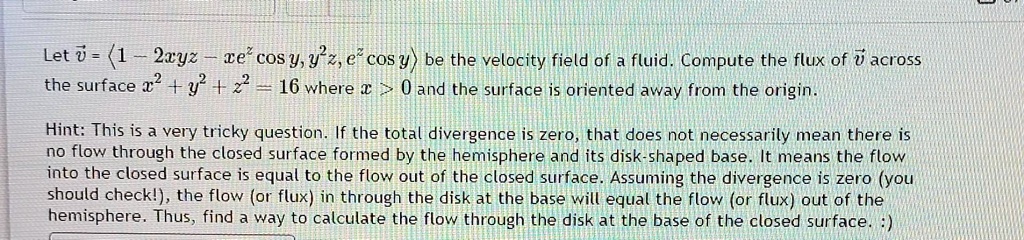
Let \(\vec{v} = (1 - 2xyz - xe^z \cos y, y^2z, e^z \cos y)\) be the velocity field of a fluid. Compute the flux of \(\vec{v}\) across the surface \(x^2 + y^2 + z^2 = 16\) where \(x > 0\) and the surface is oriented away from the origin.
Hint: This is a very tricky question. If the total divergence is zero, that does not necessarily mean there is no flow through the closed surface formed by the hemisphere and its disk-shaped base. It means the flow into the closed surface is equal to the flow out of the closed surface. Assuming the divergence is zero (you should check!), the flow (or flux) in through the disk at the base will equal the flow (or flux) out of the hemisphere. Thus, find a way to calculate the flow through the disk at the base of the closed surface. :)