Reason:
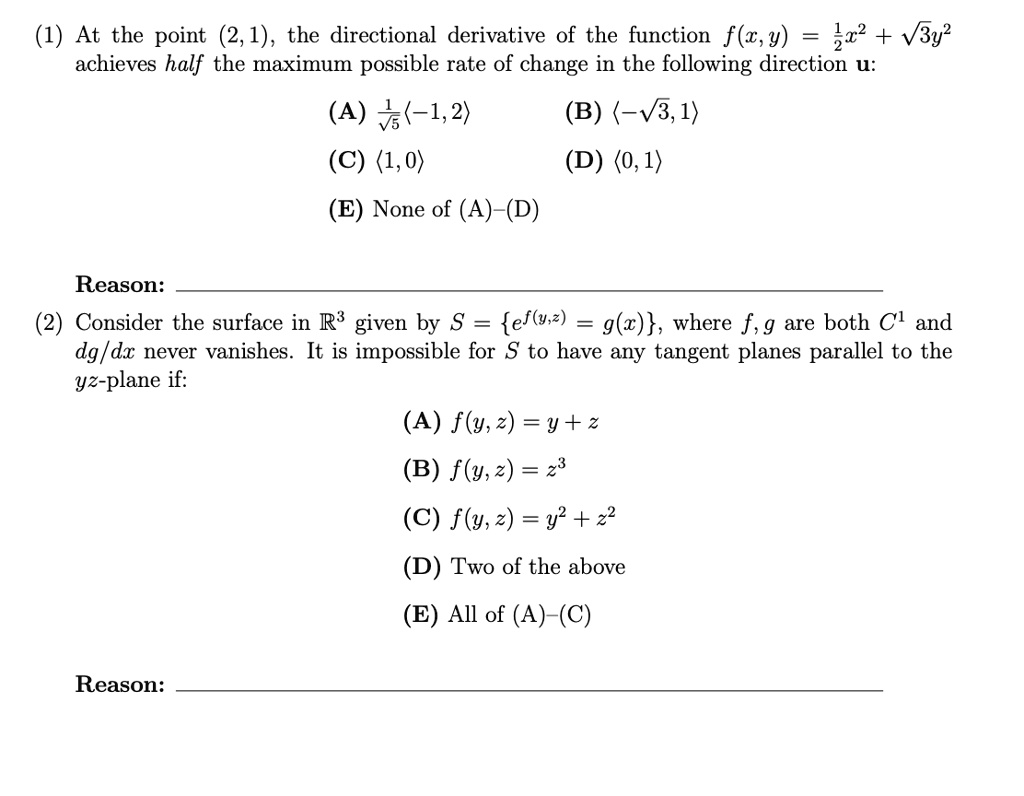
(2) Consider the surface in R^(3) given by S={e^(f(y,z))=g(x)}, where f,g are both C^(1) and
d(g)/(d)x never vanishes. It is impossible for S to have any tangent planes parallel to the
yz-plane if:
(A) f(y,z)=y+z
(B) f(y,z)=z^(3)
(C) f(y,z)=y^(2)+z^(2)
(D) Two of the above
(E) All of (A)-(C)
Reason: