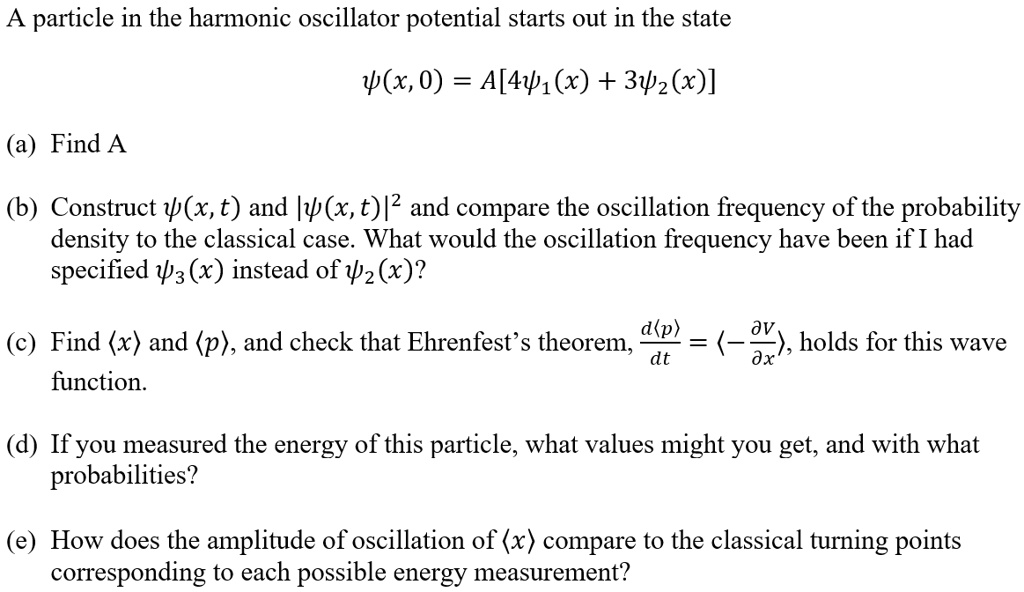
A particle in the harmonic oscillator potential starts out in the state
?(x, 0) = A[4??\(x\) + 3??\(x\)]
(a) Find A
(b) Construct ?\(x, t\) and |?\(x, t\)|² and compare the oscillation frequency of the probability
density to the classical case. What would the oscillation frequency have been if I had
specified ??\(x\) instead of ??\(x\)?
(c) Find \(x\) and \(p\), and check that Ehrenfest's theorem, $\frac{d\langle p\rangle}{dt} = \langle -\frac{\partial V}{\partial x}\rangle$, holds for this wave
function.
(d) If you measured the energy of this particle, what values might you get, and with what
probabilities?
(e) How does the amplitude of oscillation of \(x\) compare to the classical turning points
corresponding to each possible energy measurement?