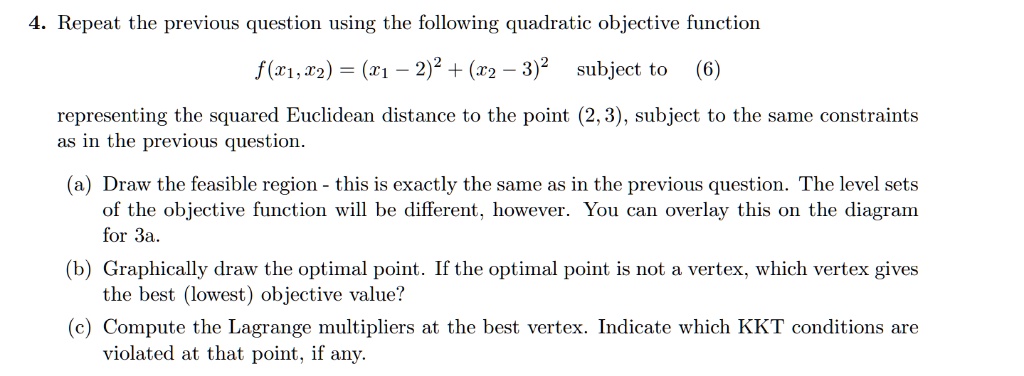
4. Repeat the previous question using the following quadratic objective function
f(x1,x2) = (x1-2)^2+(x2-3)^2 subject to (6)
representing the squared Euclidean distance to the point (2,3), subject to the same constraints
as in the previous question.
(a) Draw the feasible region - this is exactly the same as in the previous question. The level sets
of the objective function will be different, however. You can overlay this on the diagram
for 3a.
(b) Graphically draw the optimal point. If the optimal point is not a vertex, which vertex gives
the best (lowest) objective value?
(c) Compute the Lagrange multipliers at the best vertex. Indicate which KKT conditions are
violated at that point, if any.