Ace - AI Tutor
Ask Our Educators
Textbooks
My Library
Flashcards
Scribe - AI Notes
Notes & Exams
Download App
caitlin martinez

caitlin m.

Divider

Questions asked

BEST MATCH

Economics can decide a. All of the responses are correct. b. the appropriate trade-off between fairness and efficiency. c. whether a pricing decision will impose heavy inefficiency costs on society. d. which pricing arrangements are fair and which are unfair.

View Answer
divider
BEST MATCH

18. ?? ???? ??? ? ???? ??? ?????. (4?) 2Al(s) + 3H2SO4(aq) ? Al2(SO4)3(aq) + 3H2(g)

View Answer
divider
BEST MATCH

(c) $log_6 81 = \boxed{} log_6 3$

View Answer
divider
BEST MATCH

Some microorganisms can produce proteases ( enzymes that destroy proteins) specifically targeted to C5a. These organisms will be able to prevent Question 8 options: opsonization phagocytosis inflammation chemotaxis

View Answer
divider
BEST MATCH

FIGURE 16-20 Determining the forces for Example 16-4. (a) The directions of the individual forces are as shown because \( \overrightarrow{\mathbf{F}}_{32} \) is repulsive (the force on \( Q_{3} \) is in the direction away from \( Q_{2} \) because \( Q_{3} \) and \( Q_{2} \) are both positive) whereas \( \vec{F}_{31} \) is attractive ( \( Q_{3} \) and \( Q_{1} \) have opposite signs), so \( \overrightarrow{\mathbf{F}}_{31} \) points toward \( Q_{1} \). (b) Adding \( \overrightarrow{\mathbf{F}}_{32} \) to \( \overrightarrow{\mathbf{F}}_{31} \) to obtain the net force \( \mathbf{F} \). (a) (b) EXAMPLE 16-4 Electric force using vector components. Calculate the net electrostatic force on charge \( Q_{3} \) shown in Fig. 16-20a due to the charges \( Q_{1} \) and \( Q_{2} \).

View Answer
divider
BEST MATCH

If an affected individual with a rare recessive mutation is married to a normal individual, what’s the chance for their children to be affected? Group of answer choices 0 1/4 1/2 1/1 (100%)

View Answer
divider
BEST MATCH

If sodium increases in the ECF, water will move from cells to the ECF, and cells will shrink. the ECF to cells, and cells will swell. the ECF to cells, and cells will shrink. cells to the ECF, and cells will swell.

View Answer
divider
BEST MATCH

Question 2) Be Our Guest A local restaurant has asked you to help them write a program to send custom welcome messages to each guest when they check in at the kiosk. Write a complete program (you must declare variables guestName and diningHistory) that asks the customer their name and how many times they've dined at the restaurant before. If this is the customer's first visit, print "Welcome! We're so glad you're dining with us." If the customer has dined at least 6 times, print "Thank you for being a dining club member. Please enjoy complementary dessert." Otherwise, it should print "Welcome back! We're glad to have you dining with us today." (30 points) Answer is in: Pseudocode C# Java C++

View Answer
divider
BEST MATCH

Classifying systems of linear equations from graphs For each system of linear equations shown below, classify the system as \"consistent dependent,\" \"consistent independent\" or \"inconsistent\" and give the best description of its solution. If the system has exactly one solution, give its solution. System A Line 1: $y = \frac{1}{3}x + 2$ Line 2: $x + 3y = 6$ System B Line 1: $y = -2x$ Line 2: $y = -x - 1$ System C Line 1: $y = \frac{1}{2}x - 3$ Line 2: $y = \frac{1}{2}x - 4$ This system of equations is: consistent independent consistent dependent inconsistent This means the system has: a unique solution Solution: no solution infinitely many solutions This system of equations is: consistent independent consistent dependent inconsistent This means the system has: a unique solution Solution: no solution infinitely many solutions This system of equations is: consistent independent consistent dependent inconsistent This means the system has: a unique solution Solution: no solution infinitely many solutions

View Answer
divider
BEST MATCH

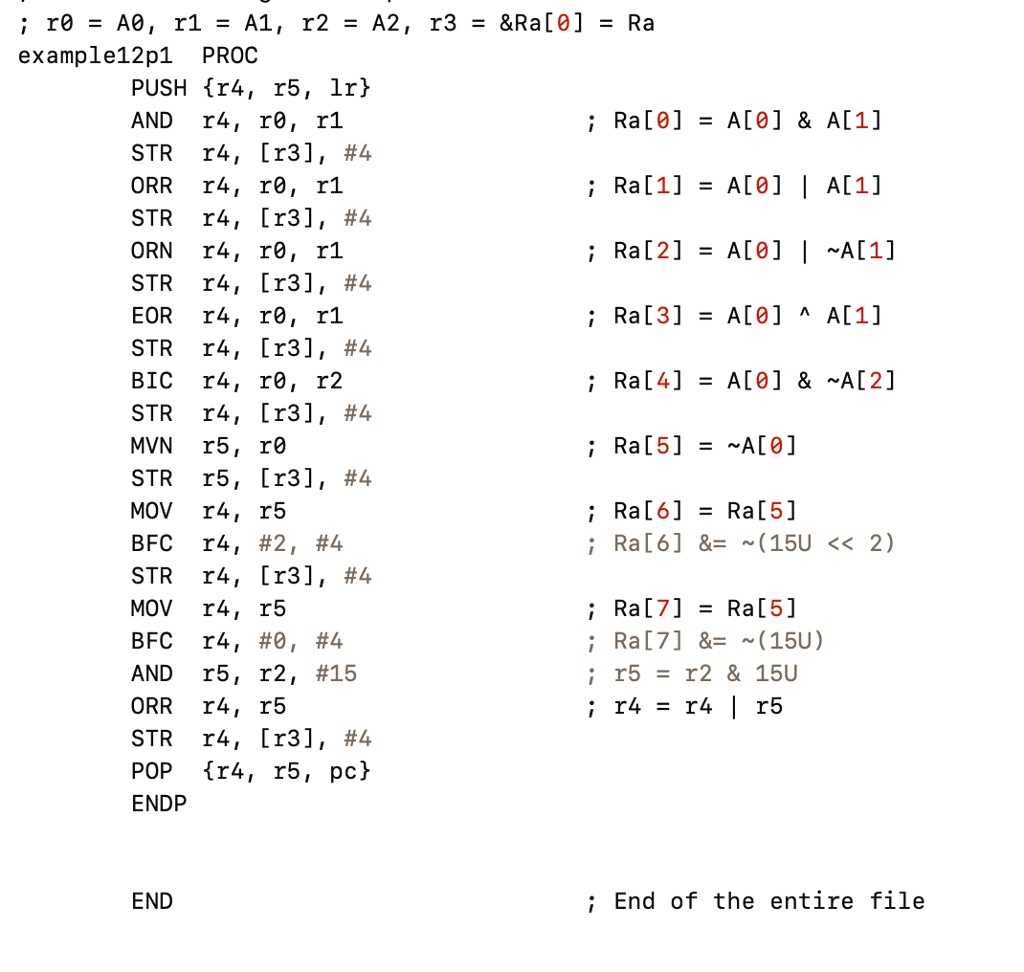
; r0 = A0, r1 = A1, r2 = A2, r3 = &Ra[0] = Ra example12p1 PROC PUSH {r4, r5, lr} AND r4, r0, r1 STR r4, [r3], #4 ORR r4, r0, r1 STR r4, [r3], #4 ORN r4, r0, r1 STR r4, [r3], #4 EOR r4, r0, r1 STR r4, [r3], #4 BIC r4, r0, r2 STR r4, [r3], #4 MVN r5, r0 STR r5, [r3], #4 MOV r4, r5 BFC r4, #2, #4 STR r4, [r3], #4 MOV r4, r0 BFC r4, #0, #4 AND r5, r2, #15 ORR r4, r5 STR r4, [r3], #4 POP {r4, r5, pc} ENDP END ; Ra[0] = A[0] & A[1] ; Ra[1] = A[0] | A[1] ; Ra[2] = A[0] | ~A[1] ; Ra[3] = A[0] ^ A[1] ; Ra [4] = A[0] & ~A[2] ; Ra[5] = ~A[0] ; Ra[6] = Ra[5] ; Ra[6] &= ~(15U << 2) ; Ra[7] = Ra[5] ; Ra[7] &= ~(15U) ; r5 = r2 & 15U ; r4 = r4 | r5 ; End of the entire file
View Answer
divider