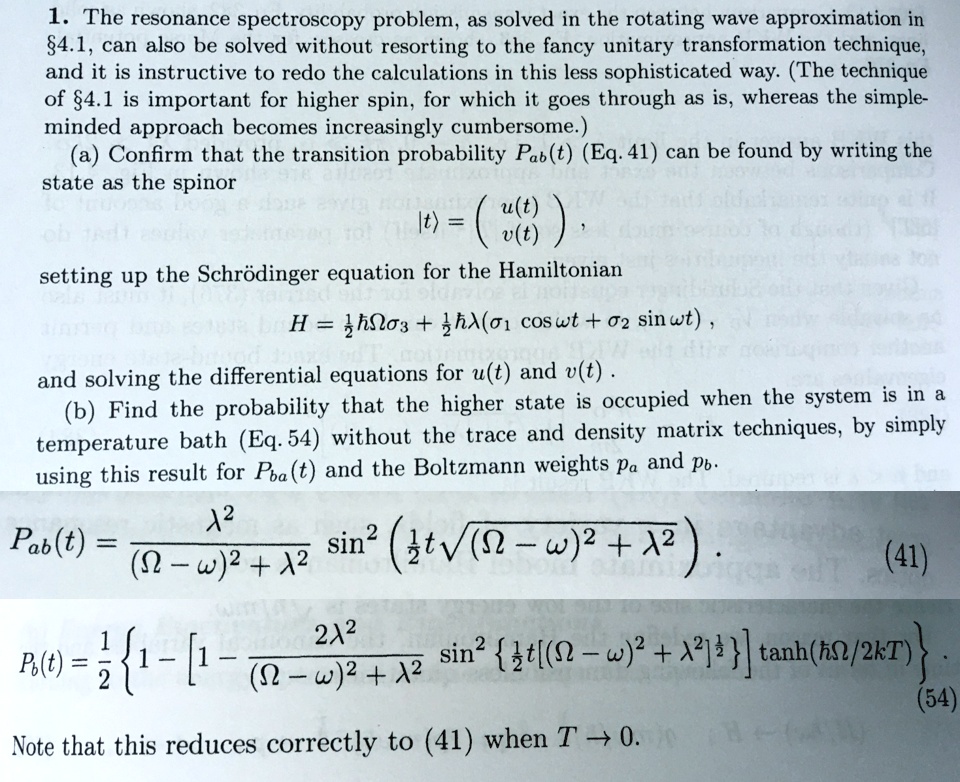
This problem is at p.228 of Quantum mechanics: fundamentals second edition, Kurt Gottfried & Tung-Mow Yan.
4.1 can also be solved without resorting to the fancy unitary transformation technique, and it is instructive to redo the calculations in this less sophisticated way. (The technique of 4.1 is important for higher spin, for which it goes through as is, whereas the simple-minded approach becomes increasingly cumbersome.)
(a) Confirm that the transition probability Pab(t) (Eq. 41) can be found by writing the state as the spinor u(t) t v(t) and setting up the Schrodinger equation for the Hamiltonian H=hSlo3+3hX(o1 coswt+o2 sinwt) and solving the differential equations for u(t) and v(t).
(b) Find the probability that the higher state is occupied when the system is in a temperature bath (Eq.54) without the trace and density matrix techniques, by simply using this result for Poa(t) and the Boltzmann weights pa and pb:
12 sin^2(3t)(-w)^2+2 -w^2+2 (41)
t) sin^2{3t[(-w)^2+X^2]3}]tanh(h/2kT) zY+z(m-U) (54)
Note that this reduces correctly to (41) when T = 0.