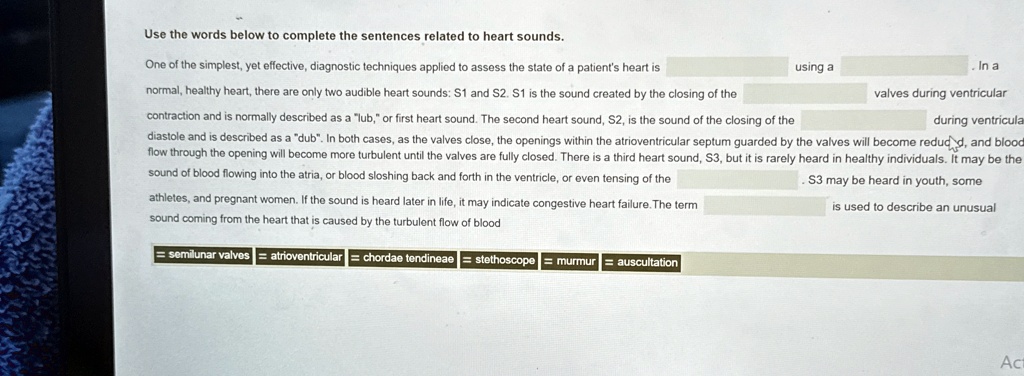
Use the words below to complete the sentences related to heart sounds.
One of the simplest, yet effective, diagnostic techniques applied to assess the state of a patient's heart is using a . In a
normal, healthy heart, there are only two audible heart sounds: S1 and S2. S1 is the sound created by the closing of the valves during ventricular
contraction and is normally described as a "lub," or first heart sound. The second heart sound, S2, is the sound of the closing of the during ventricula
diastole and is described as a "dub". In both cases, as the valves close, the openings within the atrioventricular septum guarded by the valves will become reduced, and blood
flow through the opening will become more turbulent until the valves are fully closed. There is a third heart sound, S3, but it is rarely heard in healthy individuals. It may be the
sound of blood flowing into the atria, or blood sloshing back and forth in the ventricle, or even tensing of the . S3 may be heard in youth, some
athletes, and pregnant women. If the sound is heard later in life, it may indicate congestive heart failure. The term is used to describe an unusual
sound coming from the heart that is caused by the turbulent flow of blood
= semilunar valves = atrioventricular = chordae tendineae = stethoscope = murmur = auscultation
Act