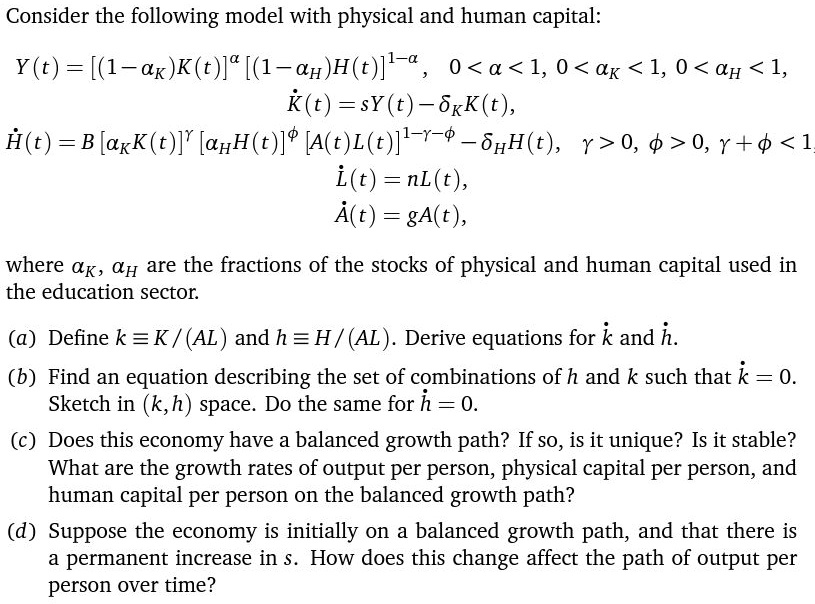
Consider the following model with physical and human capital:
Y(t) = [(1-??)K(t)]^? [(1-?H)H(t)]^(1-?), 0 < ? < 1, 0 < ?? < 1, 0 < ?H < 1,
\dot{K}(t) = sY(t) - ??K(t),
\dot{H}(t) = B [??K(t)]^? [?HH(t)]^? [A(t)L(t)]^(1-?-?) - ?HH(t), ? > 0, ? > 0, ? + ? < 1
\dot{L}(t) = nL(t),
\dot{A}(t) = gA(t),
where ??, ?H are the fractions of the stocks of physical and human capital used in
the education sector.
(a) Define k = K / (AL) and h = H/(AL). Derive equations for k and h.
(b) Find an equation describing the set of combinations of h and k such that \dot{k} = 0.
Sketch in (k,h) space. Do the same for \dot{h} = 0.
(c) Does this economy have a balanced growth path? If so, is it unique? Is it stable?
What are the growth rates of output per person, physical capital per person, and
human capital per person on the balanced growth path?
(d) Suppose the economy is initially on a balanced growth path, and that there is
a permanent increase in s. How does this change affect the path of output per
person over time?