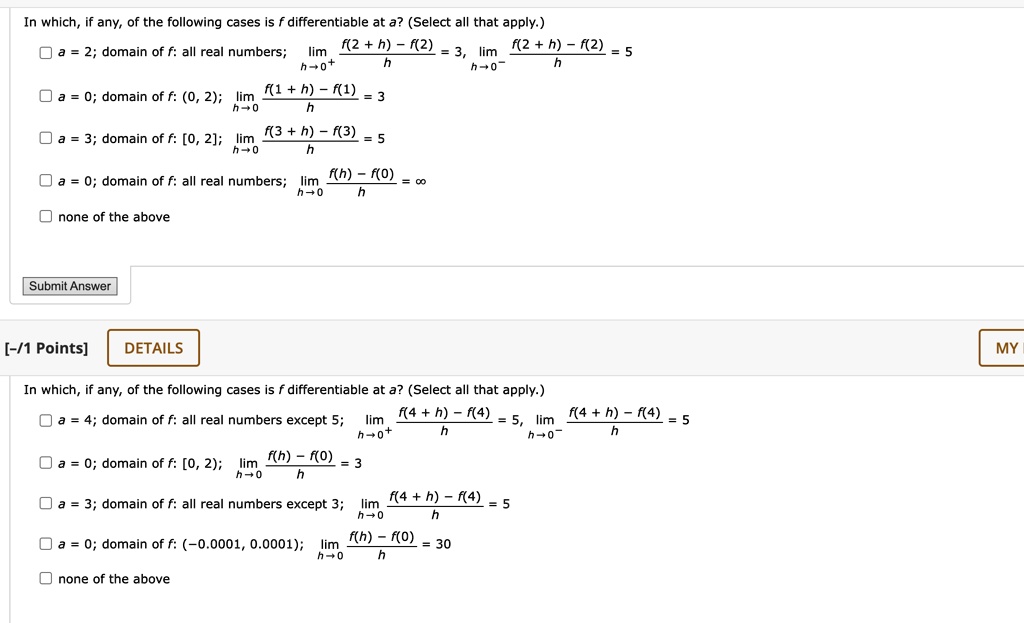
In which, if any, of the following cases is f differentiable at a ? (Select all that apply.)
a=2; domain of f : all real numbers; lim_(h->0^(+))(f(2+h)-f(2))/(h)=3,lim_(h->0^(-))(f(2+h)-f(2))/(h)=5
a=0; domain of f:(0,2);lim_(h->0)(f(1+h)-f(1))/(h)=3
a=3; domain of f:[0,2];lim_(h->0)(f(3+h)-f(3))/(h)=5
a=0; domain of f : all real numbers; lim_(h->0)(f(h)-f(0))/(h)=infty
none of the above
[-/1 Points]
In which, if any, of the following cases is f differentiable at a? (Select all that apply.)
a=4; domain of f : all real numbers except 5; lim_(h->0^(+))(f(4+h)-f(4))/(h)=5,lim_(h->0^(-))(f(4+h)-f(4))/(h)=5
a=0; domain of f:[0,2);lim_(h->0)(f(h)-f(0))/(h)=3
a=3; domain of f : all real numbers except 3; lim_(h->0)(f(4+h)-f(4))/(h)=5
a=0; domain of f:(-0.0001,0.0001);lim_(h->0)(f(h)-f(0))/(h)=30
none of the above
In which, if any, of the following cases is f differentiable at a? (Select all that apply.) a=2; domain of f: all real numbers; lim f(2 + h) -f(2)= 3, lim f(2 + h) - f(2) = 5 h0+ h h0 h a = 0; domain of f: (0, 2);lim f(1+h)-f1=3 h a = 3; domain of f: [0, 2]; lim. f(3 + h) - f(3) = 5 h a=0;domain of f:all real numbers; lim 0y-4 h0 h none of the above
Submit Answer
[-/1 Points]
DETAILS
MY
In which, if any, of the following cases is f differentiable at a? (Select all that apply.
a=4; domain of f:all real numbers except 5; lim h0+
h
h0
h
a=0;domain of f:[0,2; lim 04
h
a=3;domain of f:all real numbers except 3; lim f(4 + h) - f(4) = 5 h
a=0;domain of f:-0.0001,0.0001 Jim. h0
h
none of the above