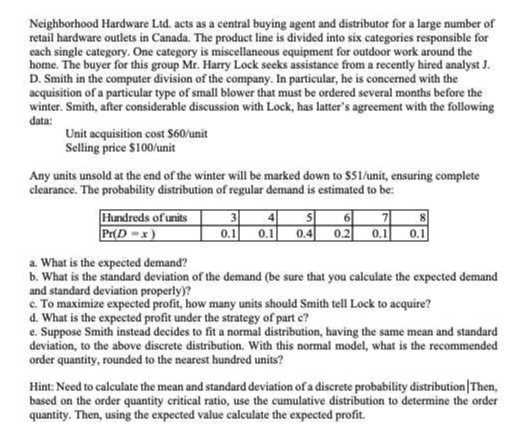
Neighborhood Hardware Ltd. acts as a central buying agent and distributor for a large number of retail hardware outlets in Canada. The product line is divided into six categories responsible for each single category. One category is miscellaneous equipment for outdoor work around the home. The buyer for this group Mr. Harry Lock secks assistance from a recently hired analyst J. D. Smith in the computer division of the company. In particular, he is concerned with the acquisition of a particular type of small blower that must be ordered several months before the winter. Smith, after considerable discussion with Lock, has latter's agreement with the following data:
Unit acquisition cost \$60/unit
Selling price \$100/unit
Any units unsold at the end of the winter will be marked down to \$51/unit, ensuring complete clearance. The probability distribution of regular demand is estimated to be:
\begin{tabular}{|l|r|r|r|r|r|r|}
\hline Hundreds of units & 3 & 4 & 5 & 6 & 7 & 8 \\
\hline \( \operatorname{Pr}(D-x) \) & 0.1 & 0.1 & 0.4 & 0.2 & 0.1 & 0.1 \\
\hline
\end{tabular}
a. What is the expected demand?
b. What is the standard deviation of the demand (be sure that you calculate the expected demand and standard deviation properiy)?
c. To maximize expected profit, how many units should Smith tell Lock to acquire?
d. What is the expected profit under the strategy of part c?
e. Suppose Smith instead decides to fit a normal distribution, having the same mean and standard deviation, to the above discrete distribution. With this normal model, what is the recommended order quantity, rounded to the nearest hundred units?
Hint: Need to calculate the mean and standard deviation of a discrete probability distribution|Then, based on the order quantity critical ratio, use the cumulative distribution to determine the order quantity. Then, using the expected value calculate the expected profit.